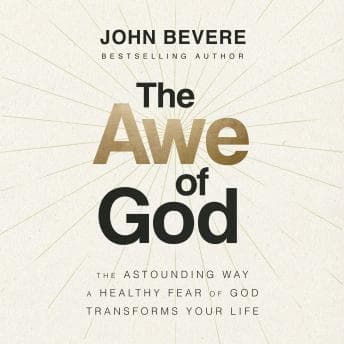

"What if you learned you were part of an experiment where the next 24 hours would determine the quality of the rest of your life?"
That's the hook Bevere opens with, and I'll be honest - I almost turned it off. I was walking the lakefront with Denise on a Saturday morning, and she gave me that look when I said I was listening to a book about eternal judgment instead of, you know, enjoying the lake. But something in Bevere's voice kept me in. Not the premise. The conviction.
The Allegory That Does the Heavy Lifting
Let's talk about what Bevere is really doing here, because the structure is unusual for a Christian living book. He doesn't just open with Scripture and build an argument. He drops you into an extended allegory - a fictional narrative about characters facing the consequences of their earthly choices in eternity. It's ambitious. It's also the kind of thing that either works brilliantly or falls flat on its face like a student presenting a book report on SparkNotes.
For me, it mostly works. The allegory gives concrete weight to abstract theological concepts. When Bevere describes characters arriving at their eternal destinations and discovering that not everyone's experience is the same - that there are degrees of reward and consequence even among the saved - it hits differently than just reading Romans 14:10. You feel the stakes. An allegory this blunt would earn eye-rolls from my juniors; it moved me anyway, because concrete pictures of consequence stick where abstract theology slides off.
Where it gets wobbly is when Bevere transitions from allegory back to exposition. The shifts can feel abrupt, like he's worried you'll get too comfortable in the story and forget this is a teaching book. I wanted him to trust the narrative more. Let it breathe. His best allegorical passages ask for a slow, attentive ear, but he sometimes rushes past his own best material to get to the Scripture references.
Bevere Reading Bevere - The Author-as-Narrator Question
Here's the thing about authors narrating their own work: you get authenticity at the cost of polish. Bevere isn't a trained voice actor, and you can tell. But what he brings is something a hired narrator couldn't fake - genuine urgency. When he reads passages about the fear of the Lord, there's a tremor in his voice that isn't performance. It's belief. He lets silence do some of the preaching too - the pauses after his sternest warnings about judgment stretch just long enough to make you sit up straighter.
His delivery is bold. Sometimes almost confrontational. If you're used to the gentle pastoral tone of, say, a Max Lucado audiobook, Bevere will feel like a bucket of cold water. He's not here to make you comfortable. He's here to shake you by the shoulders and say "this matters more than you think."
The downside? At 9 hours and 42 minutes, his voice carries the entire production solo - no music cues, no atmospheric breaks, no co-narrator to vary the texture. By hour six, I needed a palate cleanser. I switched to grading sophomore essays about The Great Gatsby, which - and I say this with love for my students - was somehow less repetitive than Bevere's third pass through the same theological point.
Who This Book Is Actually For (And Who Should Skip It)
This is not a casual listen. Not for the workout. Not for background while you're pretending to pay attention at faculty meetings. (Principal Martinez, I promise I'm talking about a different faculty meeting.) This demands your focused attention because Bevere is building a cumulative argument across chapters, and if you zone out for twenty minutes, you'll miss the scaffolding.
If you're already deep in your faith and want someone to challenge your assumptions about what eternity actually looks like beyond the binary of heaven/hell - this is your book. If you loved Bevere's The Bait of Satan, this is its spiritual successor in terms of ambition and directness. I had a similar reckoning with Jesus on Trial - that same feeling of someone building a case you didn't ask to be convinced by, and finding yourself convinced anyway.
But if you're exploring Christianity casually, or if heavy Scripture citation feels exhausting rather than energizing, this will be a slog. Bevere assumes a baseline of biblical literacy and doesn't slow down to onboard newcomers. He's preaching to the choir - but he's preaching things the choir doesn't always want to hear, which is where the value lives.
The Assignment I'd Give My Students
I keep coming back to the central conceit: that we're all living a single day that determines everything. The allegory is the visible eighth of the iceberg; underneath it is a serious, sometimes uncomfortable theology of accountability that most modern Christian books tiptoe around.
Is it life-changing? For the right listener, at the right moment, maybe. It earned the kind of undivided evening attention I usually save for grading - no small thing. But it's also a book that could've been 30% shorter and hit harder. The repetition dilutes the urgency Bevere works so hard to create.
Denise asked me what I thought when we got home from the lake. I said it felt like getting a lecture from a teacher who genuinely cares whether you pass - which, as someone who gives those lectures daily, I respect enormously. Even when it's uncomfortable. Especially then.