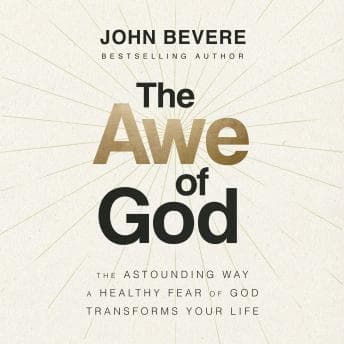

Sunday morning. Jenny's at church. I'm sitting in the kitchen with cold coffee, listening to a book about fearing God. There's a joke in there somewhere, but I'm not going to make it because Bevere would probably have something to say about that.
Here's what stopped me mid-sip about twenty minutes in: Bevere draws a hard line between being afraid of God and fearing God - and he makes the case that most modern Christianity has quietly dropped the second one because it's uncomfortable to sell in a culture that wants a cosmic life coach, not a sovereign Creator. That's not a new argument, but the way he frames it lands differently when it's in his voice, direct and unhurried, like a pastor who's decided he's done softening the edges.
I'll be honest - this is not my genre. I reviewed it because Jenny handed me her phone and said 'just listen.' She's been on a Bevere kick for months. I am a management consultant who spent a decade helping founders not blow up their companies. The fear of God is not typically in my Q3 deliverables.
But here's the thing. My parents ran a dry cleaning shop in Koreatown for thirty years. Fourteen-hour days. No sick days, no sabbaticals, no passive income streams. And they operated with this deep, almost cellular sense of accountability - not to their customers, not to the market, but to something larger. They never would've called it 'holy fear.' They would've called it how you live right. Bevere has 42 chapters and a theology degree for the same idea. This is what my parents did instinctively. Now it has a TED talk.
Bevere Narrating Bevere Is Either a Feature or a Bug
Author-narrated audiobooks are a gamble. Some authors sound like they're reading their own Wikipedia page. Bevere doesn't have that problem. He's clearly preached this material - there's a cadence here that's lived-in, not rehearsed. When he pushes on a point, you feel the weight of it. When he slows down, you slow down with him.
The production note from the book itself is that it was 'designed to be read slowly and intentionally.' That's rare self-awareness from an author. He's essentially telling you upfront: don't put me on 2.0x and expect to absorb this. I tried 1.5x. It felt wrong - like rushing a eulogy. Dropped back to 1.25x. Still felt like I was skimming something that didn't want to be skimmed. The 42-chapter devotional structure means each chapter is short, but dense. This is not commute content.
The weakness - and there is one - is that Bevere's delivery is consistently intense. There's very little tonal variation between chapters that are convicting and chapters that are meant to be encouraging. By hour four, it starts to feel like one long sermon rather than a journey with different emotional textures. If you're not already tracking the content closely, the uniform delivery can blur the chapters together.
What Bevere Is Actually Arguing (And Why It's Sharper Than the Description Suggests)
The book's thesis isn't just 'fear God more.' That would be 7.5 hours of one note. The actual argument is structural: that the fear of God functions as a sorting mechanism - it reorders every other fear you have. Fear of failure, fear of people's opinions, fear of irrelevance. Bevere's claim is that a properly calibrated fear of God makes those lesser fears collapse. The fear-of-approval angle hit me harder than I expected - I'd been sitting with similar territory in I Need Your Love - Is That True?, which dismantles the approval-seeking instinct from a completely different direction but lands in roughly the same place: the thing you're most afraid of losing is running your life. He calls it 'all lesser fears are eclipsed,' and he spends a significant portion of the book building the case from Scripture before he gets to the application.
For the business-brain listener: think of it as a hierarchy-of-values argument. If your highest value is correctly placed, every downstream decision gets cleaner. I've seen companies fail because founders feared their investors more than their customers, or feared bad press more than bad products. Bevere's making an analogous point in a spiritual register. The logic holds regardless of your starting theology.
The 42-chapter format with reflection tools at the end of each chapter is genuinely useful - and genuinely incompatible with passive listening. You will not get full value from this as background audio. That's not a criticism. That's a format requirement.
Bottom Line: This One's Not For Me To Rate Alone
Jenny finished this in a week and said it changed how she prays. I finished it in two weeks and said it changed how I think about organizational accountability structures. We're both right, probably. The key takeaway is worth the listen. The other 6 hours? Also worth it, but only if you're willing to slow down and actually sit with the material - which, for the record, I am not naturally wired to do.
If you're a skeptic picking this up for the first time, go in knowing Bevere is not interested in making you comfortable. If you're already in the faith and feel like something's been missing from your spiritual life, this might name the thing. My 2.0x speed couldn't save this one - and that's actually a compliment.