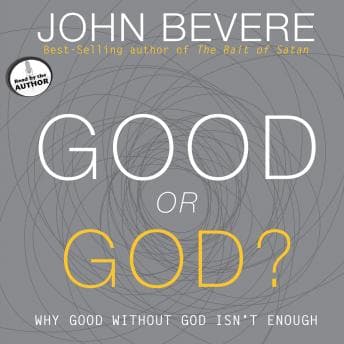

"Good is the enemy of God."
That line hit me somewhere around hour two, stuck in BART delays because Caltrain decided to be extra today. And I just sat there, coffee getting cold, thinking about how many times I've optimized for "good enough" in my life—in code, in relationships, in faith—without asking if it was actually the right direction. Girl, Wash Your Face asked similar questions about autopilot living, though from a very different angle.
Look, I'm not usually the religious audiobook type. My queue is 90% hard sci-fi and business books I listen to at 1.75x because they could've been blog posts. But my mom kept recommending Bevere, and after three months of "Sarah, you need to hear this," I caved. Partly to get her off my back. Partly because—if I'm being honest—the tech industry's version of "good" was starting to feel hollow.
The Debugging Framework You Didn't Know You Needed
Here's the core argument: Bevere says our culture has conflated "socially acceptable" with "godly," and that's a dangerous substitution. He uses the Garden of Eden as his primary case study—the Tree of Knowledge of Good AND Evil. Not just evil. Good was in there too. The implication being that humans deciding what's good independent of God is the original bug, not the original feature.
As someone who debugs distributed systems for a living, this framework actually clicked for me. We spend so much time at work building consensus systems, making sure all nodes agree on the source of truth. Bevere's essentially arguing that we've built a society where each node (person) is their own source of truth for morality, and we're surprised when the system produces inconsistent results.
Is that a stretch? Maybe. But it's 6 AM and I'm on a train. This is how my brain works.
Author-as-Narrator: The Double-Edged Sword
John Bevere reads his own book, which cuts both ways. The strength: you can hear the conviction. This isn't a hired voice actor reading words—it's a preacher who genuinely believes every sentence. There's a weight to his delivery, especially in the sections where he challenges comfortable Christianity.
The limitation: it's one gear. Passionate, sincere, direct. For 8+ hours. No character voices (obviously), no tonal variety to break things up. Around hour five, during my evening commute, I found myself zoning out not because the content was weak but because the delivery is relentlessly earnest. I bumped it to 1.5x and that helped—gave it more momentum.
If you're used to Ray Porter's range or a full-cast production, this will feel stripped down. But there's something to be said for hearing an author's actual voice, especially for content this personal.
Where It Challenges vs. Where It Coasts
Bevere doesn't pull punches on cultural Christianity—the "I'm a good person" default that substitutes church attendance and general niceness for actual relationship with God. He's got a preacher's instinct for the uncomfortable question, and he deploys it effectively.
But—and this is where my analytical brain kicks in—some sections feel more like sermon transcripts than audiobook content. There are moments where he'll make a point, illustrate it, then make it again with slightly different words. In a live sermon, that repetition builds momentum. In an audiobook on your third commute, it can feel like padding. Love and Respect had the same structural issue—great content that sometimes felt stretched thin in audio format.
The scripture-heavy sections require actual focus. This is not a background-while-coding listen. I tried that once during a low-priority PR review and retained exactly nothing. Save it for dedicated listening time when you can actually engage.
Who Should Queue This Up (And Who Should Pass)
Perfect for: Christians who feel like they're going through the motions. People who grew up in church but can't articulate why their faith is different from just "being a good person." Anyone whose mom has recommended it three times.
Skip if: You're looking for interfaith perspectives or academic theology. This is unapologetically evangelical Christian content. If that's not your framework, this won't convert you—it's written for people already inside the tent who need a wake-up call. Also skip if you need audiobooks to multitask. The ROI on this one requires actual attention.
The Commit Message
Did this change my life? That's a big claim. But it did give me a framework I keep returning to—a mental check of "is this actually aligned with what God wants, or just what feels good to me?" As someone who optimizes systems for a living, having a cleaner decision tree for moral questions is... useful.
Bevere's not subtle, and the production is bare-bones. But sometimes you don't need subtle. Sometimes you need someone to look you in the eye (metaphorically, through your AirPods, on a crowded train) and ask if you've confused the comfortable path with the right one.
I finished this in four commutes. I'm still thinking about it three weeks later. That's worth something.