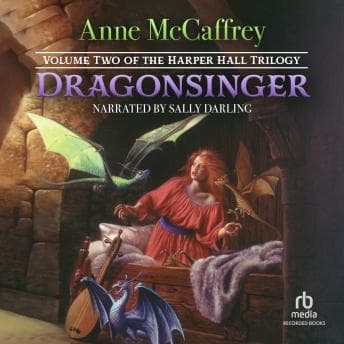

Anne McCaffrey's Dragonsinger is the middle book of the Harper Hall trilogy, and it might be the most quietly radical thing she ever wrote.
I say that because this isn't a dragon book. Not really. It's a book about a girl trying to survive an institution that doesn't want her there - and if that doesn't sound familiar to every teacher who's watched a bright kid get ground down by bureaucracy, I don't know what does.
The Faculty Meeting Nobody Wanted Her At
Menolly arrives at Harper Hall with nine fire lizards and more musical talent than half the masters combined, and the institution's response is basically: "But you're a girl." Master Morshal's hostility toward her isn't the mustache-twirling villain kind. It's the quiet, administrative, death-by-a-thousand-paper-cuts kind. The wrong room assignments. The dismissive comments in class. The assumption that she couldn't possibly belong.
McCaffrey wrote this in 1977, and honestly, I've sat in faculty meetings where the dynamic wasn't much different. Denise and I were walking the lakefront on a Saturday morning - one of those gray Chicago days where the lake looks like hammered steel - and I was deep into the section where Menolly is literally running herself ragged trying to prove she deserves her place. My wife asked why I looked annoyed. I told her the Harper Hall has a sexism problem. She said, "So does your school district." Fair point.
What makes McCaffrey's handling work is that she doesn't give Menolly a big dramatic confrontation scene. The vindication comes through competence - through showing up, doing the work, composing the songs. It's not cathartic the way a revenge fantasy is cathartic. It's satisfying the way watching a student finally believe in themselves is satisfying. Slower. Realer.
Sally Darling and the Question of Voice
Here's where I have to be honest: Sally Darling's narration is good but not great, and the gap between those two words matters at ten hours.
Her voice has this slightly old-fashioned quality - almost a mid-century radio drama feel - that actually suits Pern's quasi-medieval setting better than a modern flat delivery would. When she reads Menolly's internal moments of doubt, there's genuine warmth there. One listener called it "melodious," and that's right. She reads musically, which for a book about a musician feels appropriate.
But there are pronunciation choices that pulled me out of the story. If you've read these books - and I've been reading McCaffrey since before my students' parents were born - you've got the names locked into your head a certain way. Hearing them differently is like someone mispronouncing a friend's name at a party. Not a disaster, but you notice. Every time.
The character differentiation is also thin. This is a book with a large cast - masters, journeymen, apprentices, a Masterharper who should command every room he enters - and Darling doesn't always give them distinct enough voices to track in audio alone. Robinton, who is one of McCaffrey's great characters, deserved a voice that made you sit up straighter. I wanted more from those moments.
That said, her reading is expressive and earnest. She cares about this story. You can hear it. And for a middle-grade-adjacent fantasy, caring goes a long way.
Why This Still Matters (My Students Would Disagree)
I teach juniors who think anything written before 2010 is ancient history. My students would hate this. I love it. But here's the thing - if I handed Dragonsinger to the right kid, the one who feels invisible, the one who's talented but convinced nobody sees it? That kid would devour it.
McCaffrey understood something about institutional power that a lot of fantasy writers skip right over. Pern has dragons and Thread and all the genre furniture, but the Harper Hall trilogy is really about how institutions shape people - for good and for ill. Menolly's nine fire lizards aren't just cool pets (though they are). They're proof of her competence that the system can't dismiss, can't grade away, can't file in a drawer. They're living, singing, undeniable evidence that she is who she says she is.
If you loved Dragonsong - the first book - this is its spiritual successor in the truest sense. Same heart, slightly broader scope. McCaffrey shifts from survival story to social story, and the transition works because Menolly's core problem hasn't changed. That same arc — talented outsider grinding against a system built for someone else — is something I saw handled with surprising grit in Rogue Knight, though the setting couldn't be more different. She's still fighting to be heard.
The Assignment
This audiobook is for McCaffrey completists and for anyone introducing a younger listener to Pern. The narration is warm enough to carry you through, even if it won't blow you away. Listen at 1.0x - the prose deserves to be savored, and McCaffrey's pacing is deliberate by design. This is a middle book, so yes, it's doing setup work for Dragondrums, but it earns its own emotional weight.
Worth pausing the faculty meeting for? Maybe not Darling's performance specifically. But Menolly's story? Absolutely. Every time.