"The main misfortune, the root of all the evil to come, was the loss of confidence in the value of one's own opinion." That line hit me somewhere around hour six, sitting on my back porch at midnight with Ranger snoring at my feet and a bourbon I'd forgotten to drink. Pasternak wrote that about revolutionary Russia, but I've watched that exact thing happen in briefing rooms and boardrooms alike.
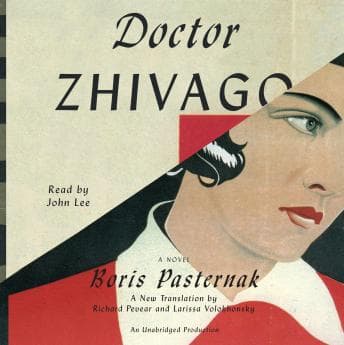
Let me cut to the chase: Doctor Zhivago is not a fast book. It's not an action book. At 23 hours and 19 minutes, it's a serious commitment — longer than most deployments feel when you're in the thick of it. But it's one of the most honest portrayals of what happens to ordinary people when history decides to use them as kindling that I've ever encountered.
A Revolution That Doesn't Care About You
Here's what Pasternak gets right that most Western writers botch when they tackle Russia: the Revolution isn't a backdrop. It's not set dressing. It seeps into everything — the train schedules, the food supply, the conversations people are afraid to have. Zhivago doesn't charge into battle or lead some resistance. He's a doctor and a poet trying to keep his family alive while the Whites and Reds tear the country apart around him. He gets conscripted by partisans. He watches civilization unravel not in dramatic explosions but in the slow disappearance of firewood and medicine. The quiet devastation of ordinary life interrupted by forces nobody asked for — I ran into that same territory in Selected Short Stories, where a few of those pieces gut-punch you with exactly that kind of compressed, civilian-level loss.
I've seen this scenario play out in real life — not in Russia, obviously, but the way civil conflict grinds down civilians. The way people make impossible choices not out of heroism but exhaustion. Pasternak nails that. Some listeners apparently wanted more granular detail about the Revolution's daily impact, and I get that complaint. But honestly, the book's power is in how the political becomes intensely personal. You feel the cold. You feel the hunger. You feel the slow suffocation of a man who just wants to write poems and practice medicine while the world demands he pick a side.
The Pevear and Volokhonsky translation — this is their version, the same team that tackled War and Peace — has a rhythm to it that feels deliberate. Long, winding passages about landscape and light that suddenly snap into sharp, almost brutal clarity when violence intrudes. It reads (or in this case, sounds) like Pasternak intended: lyrical but never soft.
John Lee Earns His Keep Over 23 Hours
Twenty-three hours with one narrator is a trust exercise. You're locked in a C-17 with this voice and there's no parachute. John Lee is worth the flight time. The man handles Russian names and patronymics without a single stumble that I caught — and believe me, I was listening for them. Yuri Andreievich, Larisa Fyodorovna, Antipov, Komarovsky — he moves through them like he's been speaking Russian his whole life.
What impressed me most was his restraint. This is a book with enormous emotional weight — Zhivago's love for Lara, the death of people close to him, the grinding despair of the civil war years — and Lee doesn't oversell any of it. He trusts the prose. His reading of Zhivago's poetry sections (yes, the novel includes actual poems at the end) carries genuine feeling without tipping into melodrama. There's a passage describing Zhivago recognizing Lara across a room that Lee delivers with just the slightest shift in tempo, almost a held breath. That's craft.
I bumped up to 1.25x as usual, and it worked fine for maybe 80% of the book. But those dense descriptive passages — the Ural Mountains, the train journeys, the frozen landscapes — I actually dropped back to 1x a few times. They needed the space.
Who This Is For (And Who Should Run)
Worth your time? Here's the debrief. If you want explosions and gunfights, this isn't your book. Linda would've quit by hour three. If you want a deeply human story about survival, love, and the cost of political upheaval told by a man who actually lived through it and was persecuted for writing about it — this is essential listening.
This is a focused-listening book. Do not attempt this on a crowded gym floor or while half-paying attention in traffic. I listened mostly during late nights and early mornings when the house was quiet. The book demands that.
Some readers know Zhivago only from the 1965 film. The novel is a different animal — messier, more philosophical, less romantic in the Hollywood sense. The love story between Zhivago and Lara is there, but it's tangled up in guilt and circumstance and the sheer brutality of trying to stay alive. It's not sweeping violins. It's two people clinging to each other because everything else has been stripped away.
Pasternak was banned in his own country for writing this. He turned down the Nobel Prize because the Soviets threatened him. The book survived anyway. That tells you something about its power.
Mission Debrief: 23 Hours Well Spent
Ranger approved this one — mostly because it kept me sitting still long enough for him to sleep on my feet for several consecutive evenings. But I approved it too. Doctor Zhivago is the kind of book that changes how you think about a period of history you thought you understood. It's long, it's demanding, and it rewards every minute. John Lee's narration is the right vehicle for Pasternak's prose — steady, intelligent, and deeply felt without ever showboating.
Not every mission is fast. Some of the most important ones are slow, grueling, and quiet. This is one of those.