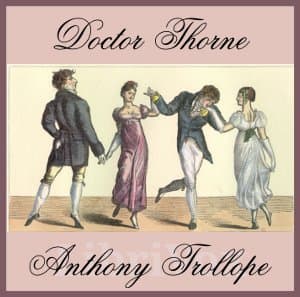

Twenty-two hours. Twenty-two hours of Victorian social maneuvering, and I'm genuinely annoyed that it's over.
Let me complain about something first, because I teach teenagers and complaining is my love language. Trollope spends roughly forty-seven pages (I'm estimating, but emotionally accurate) on whether Mary Thorne is technically a "lady" in the county sense. The county sense! As if there's a standardized test for gentility administered by local gentry. My students would riot. They'd demand a rubric. And honestly? I was riveted. This is my problem now.
Why Good People Make Bad Television But Excellent Audiobooks
Here's what Trollope does that shouldn't work: he writes genuinely decent human beings and makes you care about them. Mary Thorne is good. Not "secretly harboring darkness" good, not "complicated antihero" good. Just... good. Frank Gresham loves her honestly and without manipulation. Doctor Thorne himself is the kind of man you'd want making house calls—principled, warm, protective of his niece without being overbearing.
This is death for most fiction. We're trained to need conflict, dysfunction, moral ambiguity. I've seen this same challenge tackled in Identicals: A Novel, where the author has to make fundamentally decent characters compelling without resorting to manufactured drama. But Trollope understood something my AP Lit students never believe until they experience it: watching good people navigate a world that punishes goodness is its own kind of tension. The de Courcy relatives circling like aristocratic vultures, the financial pressures squeezing the Greshams, the class barriers that make Mary's very existence a social impossibility—the conflict comes from *outside* these people, and we're desperate for them to survive it intact.
Nicholas Clifford gets this. His narration has a warmth that matches Trollope's affection for his characters. The introduction he provides sets up the novel's central challenge—making good people interesting—and then he proceeds to prove it can be done.
The Pace Trollope Intended (And Yes, I'm Listening at 1.0x)
My students think I'm ancient for refusing to speed up audiobooks. They're not wrong about the ancient part. But this is exactly why I hold the line. At twenty-two hours, Doctor Thorne demands patience. The prose is meant to unspool slowly, the social observations meant to accumulate like evidence in a trial. The de Courcy family's casual cruelty doesn't hit you all at once—it builds through dozens of small cuts, each one making you more protective of Mary.
I listened to most of this grading papers at 11 PM (sorry, Denise, I know you wanted to watch that cooking show) and during my lakefront walks. The novel rewards both states. Distracted grading mode? You'll catch the plot. Focused walking mode? You'll catch Trollope's sly commentary on how money and blood determine everything in Barsetshire, and how absurd he finds the whole arrangement.
Clifford's pacing matches the material. This isn't a performance that demands attention through vocal fireworks. It's steady, clear, confident in the text. For a LibriVox recording, the audio quality holds up remarkably well across the full runtime.
The Financial Subplot Your Economics Teacher Would Love
Here's something nobody warned me about: this novel is secretly about money. Property. Inheritance. The Gresham estate is mortgaged to the hilt, Frank is expected to marry wealth to save the family, and Mary's lack of fortune makes her love for Frank practically criminal in the eyes of society. Trollope tracks every pound, every acre, every entailment with the precision of an accountant who also happens to be a romantic.
Show the iceberg's tip, and the mass below will make itself felt. Trollope shows you the tip (young love thwarted by class) but the mass below (Victorian England's entire economic and social machinery) is what gives it weight.
Who This Is Actually For
If you loved Middlemarch—and I mean really loved it, not just survived it for a grade—this is its spiritual successor. Different author, similar patience required, same reward. Perfect for surviving a long project, a road trip, or a semester of faculty meetings (Principal Martinez, still not listening to your budget presentations).
Skip it if you need action, if slow burns frustrate you, or if Victorian class distinctions make you want to throw things. Fair warning: you will want to throw things at the de Courcy family. That's intentional.
Mr. Williams's Final Grade
The prose deserves to be savored. Trollope writes with such affection for his characters that you finish the novel feeling like you've spent three weeks in Barsetshire, and you're a little sad to leave. Clifford's narration serves the text faithfully—no showboating, no distracting choices, just clear delivery of genuinely excellent Victorian fiction.
My students would hate this. I love it. Twenty-two hours well spent.