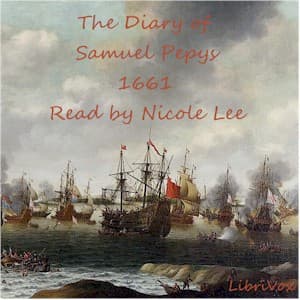

Samuel Pepys is the original startup founder who actually kept receipts.
I was up at midnight cleaning out my home office — Jenny's been on me about the filing situation — and I put this on thinking a 17th-century diary would be decent background noise while I sorted tax documents. Instead I found myself sitting on the floor next to a pile of old McKinsey engagement letters, genuinely fascinated by a guy who's been dead for over 300 years.
The OG Operator Who Documented Everything
Here's what you need to know about Pepys: this man was running the Royal Navy's administrative apparatus during one of the most chaotic periods in English history, and he wrote down everything. His morning wine. His arguments with his wife. His political maneuvering. His money anxieties. His social climbing. This is 1661 — the second year of the diary — and Charles II is settling into the throne while Pepys is figuring out how to consolidate power in the Admiralty.
What struck me is how much this reads like the internal monologue of a mid-level executive who's simultaneously brilliant and petty. One entry he's strategizing about naval contracts, the next he's obsessing over whether he overpaid for a pair of gloves. The man tracks his net worth with the precision of a Series A founder watching burn rate. He literally tallies his money at the end of entries. This is what my parents did instinctively — obsessive financial tracking, relentless work ethic, the constant calculation of whether you're getting ahead or falling behind. Now it has a TED talk. Maya Angelou documents that same grinding self-inventory in I Know Why the Caged Bird Sings — a different era, a radically different life, but that same relentless accounting of where you stand and what it costs you to keep moving. Or in this case, a 360-year-old diary.
The key takeaway is worth the listen. The other 7 hours? Well, it's only 5 hours 48 minutes, and most of it is genuinely interesting, which is more than I can say for 90% of the business memoirs in my Audible library. Pepys doesn't pad. He wrote daily entries, so you get density — political intrigue, domestic drama, professional hustle, all compressed into these short bursts. At 2.0x speed, I moved through this in basically one evening.
The Elephant in the Recording Booth
Okay. Nicole Lee. Let's talk about this.
She's reading a man's private diary. A very male diary — Pepys writes about his attractions, his ego, his physicality with zero filter. And the narrator is a woman. Some listeners have strong feelings about this, and I get it. There's an unavoidable cognitive friction when you hear a female voice say things like — well, things Pepys says about the women he encounters. It creates a weird distancing effect, like watching a dubbed film where the voice doesn't quite match the mouth.
But here's where I surprised myself: after about 45 minutes, I stopped noticing. Lee reads this as a LibriVox volunteer production, so we're not talking about a $200-an-hour studio narrator. The production is clean, the pacing is steady, and she treats the material with a straightforward, no-drama delivery that actually works for a diary format. She's not trying to perform Pepys. She's reading his words. And since these are short, date-stamped entries rather than dramatic scenes, the format carries itself.
Is it ideal? No. Would a male narrator with some period sensibility have been better? Probably. But this is a free LibriVox recording, and Nicole Lee did solid, committed work. I've paid $25 for audiobooks with worse narration. Jenny would say I'm being harsh. Jenny is right — Lee deserves credit for tackling a massive text and delivering it consistently.
Who Gets ROI From a 362-Year-Old Diary
If you're a business biography junkie who's burned through every Isaacson and Chernow, this is a genuinely different experience. You're not getting a biographer's polished narrative — you're getting raw source material. Pepys doesn't know he's writing for posterity. He's just... documenting his life. And that honesty is more useful than most curated business memoirs.
If you want lessons in organizational politics, patron management, financial discipline, and career navigation — it's all here, just dressed in 17th-century English. If you need a structured framework with action items and chapter summaries, skip this entirely.
I've seen founders obsess over "first principles thinking" like it's some Silicon Valley invention. Pepys was doing it in 1661, managing naval supply chains and navigating court politics without a single podcast to guide him. The man was operating in a world with no playbook, and he wrote his own.
The Dry Cleaner's Son's Recommendation
Bottom line: this is a fascinating primary source delivered in a no-frills audio package. The female narrator is a legitimate concern that fades faster than you'd expect. At under 6 hours, it respects your time — which is more than I can say for the last three business books I abandoned at the 40% mark. It's free through LibriVox, so the ROI calculation is pretty simple. Worth streaming on a late night when you want something genuinely different from the usual productivity content.






![Steve Jobs [unabridged audiobook] audiobook cover](/_next/image?url=https%3A%2F%2Fcovers.audiobooks.com%2Fimages%2Fcovers%2Ffull%2F9788499923406.jpg&w=1920&q=75)