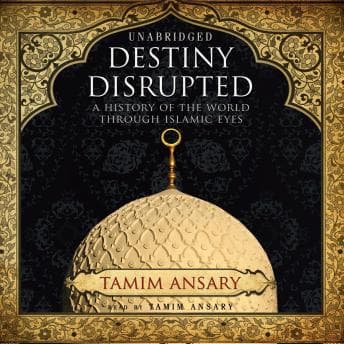

I expected a textbook. I mean, 17 and a half hours on Islamic history? I was prepping myself for the kind of dense, lecture-hall slog that makes you zone out somewhere around the Abbasid Caliphate and never come back. But I was cooking biryani on a Sunday — the kind of elaborate, four-hour biryani my mother would approve of — and I figured, fine, let's see how far I get before I switch to a podcast.
I didn't switch.
The Parallel Universe Problem
What makes this book genuinely fascinating as a case study in collective psychology is Ansary's central framework: that for roughly a thousand years, two civilizations — Western Christendom and the Islamic world — existed side by side, each convinced it was the main character. Each had its own plot, its own turning points, its own sense of narrative destiny. And then, around 1800, one narrative bulldozed the other.
I kept thinking that same tension — two worlds running in parallel, each the hero of its own story — is what drives Tale of Two Cities, though Dickens squeezes it into a single revolution instead of a thousand years.I found myself asking: why does the West's version of world history feel so natural to most of us? Ansary doesn't answer that with anger or polemic. He answers it structurally. He literally walks you through the Islamic world's internal storyline — the rise of the khalifate, the fracturing into competing dynasties, the Mongol devastation, the Ottoman and Mughal and Safavid empires — and shows you how each event felt from inside that narrative. The Crusades, for instance, barely register as a major event in the Muslim world's story. They were a border nuisance. A sideshow. Meanwhile, we in the West treat them as this epic civilizational clash. That asymmetry alone is worth the entire listen.
The research actually shows that people construct identity through the stories their culture tells about itself — not through raw facts, but through which facts get emphasized and which get left out. Ansary understands this instinctively. He's not just giving you history. He's giving you the psychology of how a civilization processes its own experience.
When the Author Is Also the Narrator (And It Works)
Look, author-narrated audiobooks are a gamble. Half the time you get someone who wrote a brilliant book and then reads it like they're filling out a tax form. Ansary is the exception. His delivery is clear and conversational — like a really good professor who happens to be talking just to you over chai. He doesn't do voices (there's no need; this isn't fiction), but there's a warmth and a quiet authority that keeps you engaged through sections that could easily get dry. The Umayyad-Abbasid transition? The theological differences between Sunni and Shia? He makes you care about the internal logic of these splits because he frames them the way a storyteller would — as human conflicts with human motivations.
What I particularly noticed is that he never slips into soapboxing. At 17 hours, that's remarkable restraint. He's Afghan-American, so he obviously has skin in this game, but the tone stays genuinely even. When he discusses the Western colonial encounter, he presents the Muslim world's sense of disruption without making the West into a cartoon villain. When he discusses internal Muslim conflicts — the sectarian divisions, the failures of governance — he doesn't flinch either. My therapist would have thoughts about this kind of emotional regulation. It's hard-won.
What Your World History Class Skipped
The section that hit me hardest — and I wasn't expecting this — was Ansary's treatment of the period between roughly 750 and 1200 CE, when the Islamic world was the center of intellectual innovation. He doesn't present this as a gotcha or a guilt trip. He presents it as a natural consequence of the story he's been telling: a civilization that, at that moment, had the infrastructure and the motivation to translate, synthesize, and build on Greek, Persian, and Indian knowledge. And then he shows you how the Mongol destruction of Baghdad in 1258 — the burning of the House of Wisdom, the massacre of scholars — became a civilizational trauma that still echoes. The protagonist exhibits classic post-traumatic reorganization: a turn inward, toward conservatism and preservation rather than expansion.
Psychologically, this tracks. When a community experiences catastrophic loss, it often retreats to what feels safest. Ansary connects this pattern across centuries without being reductive about it.
The one thing I'll flag: this is genuinely a focused listen. I tried switching to it during a morning jog a few days later and found I was missing connective threads. The information density is real. This isn't background material. Give it your full attention or you'll lose the architecture of his argument.
Who Needs This in Their Ears
If you've ever looked at headlines about the Muslim world and thought "I'm missing context" — yes, you are, and this is the context. If you're a history reader who's tired of the same Western-centric timeline, this reframes everything without being polemical about it. If you need action and drama every ten minutes, this probably isn't your speed; it's 17 hours of ideas, not battles. The opposite craving — scrappy underdogs, drawn swords, obvious villains — I scratch with Green Ember: The Green Ember Book I, and it's a good reminder that not every great listen has to be heavy. But if you're the kind of person who finds the psychology of civilizations genuinely interesting — how groups of millions construct a shared story about who they are — this is one of the best things I've listened to this year.
My Diagnosis
I started this expecting homework and finished it feeling like I'd been given a second lens for my own brain. Ansary wrote the book the world needed and then had the decency to narrate it himself, well. The biryani turned out great, by the way. Maa would be proud. Of the biryani, at least. She'd still wonder why I need another book.