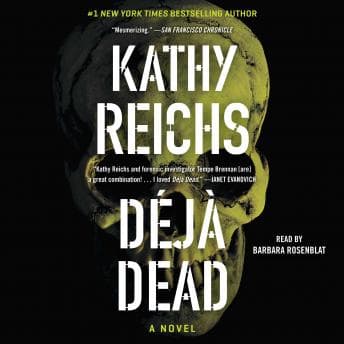

Let me cut to the chase - I spent sixteen hours with a forensic anthropologist who makes decisions that would get her court-martialed in any military unit I've ever commanded. And I couldn't stop listening.
Kathy Reichs knows her stuff. That's not surprising given she's actually a board-certified forensic anthropologist, but it shows on every page. The way Temperance Brennan examines those dismembered remains, cataloging cut marks and bone fragments - this isn't Hollywood forensics. This is the real deal. I've worked with enough crime scene analysts during my consulting work to recognize authentic procedure when I hear it. Reichs clearly did more than homework here. She wrote the textbook.
When Your Protagonist Needs a Tactical Intervention
Here's where Brennan lost me repeatedly - and I mean repeatedly. This woman has the situational awareness of a second lieutenant on his first deployment. She finds evidence of a serial killer, gets stonewalled by Quebec police, and her response is to investigate solo. At night. In isolated locations. Without backup or even a decent comm plan.
I was listening during a three-hour drive to Houston for a client meeting, and I actually said out loud to Ranger (who was riding shotgun because Linda was out of town) - "Ma'am, what in the actual hell are you doing?" He tilted his head like he agreed.
But here's the thing - it works. Reich builds the tension so methodically that even when you're screaming at Brennan to call for backup, you're completely hooked. The killer's pattern emerges slowly, piece by piece, and by the time Brennan's daughter and best friend enter the danger zone, the stakes feel genuinely personal.
Rosenblat's Quebec Comes Alive
Barbara Rosenblat earned her paycheck on this one. Her French-Canadian accents aren't the cartoonish "hon hon hon" garbage you get from narrators who clearly never left the continental US. She gives Brennan's French dialogue a slight American accent - exactly how an expat would sound after a year in Quebec. The local cops, the medical examiners, the various Montreal characters - each gets distinct vocal treatment that never slides into caricature.
Her timing during the autopsy scenes deserves special mention. There's a clinical precision to how she delivers the forensic details that mirrors Brennan's professional detachment. Then when the emotional weight hits - when Brennan realizes how close the killer has gotten to her own life - Rosenblat shifts gears without making it feel theatrical. Vanishing Man has that same balance—procedural detail that suddenly becomes deeply personal when the investigator's world gets invaded.
Fair warning though: don't listen while prepping dinner. I was marinating steaks when a particularly graphic dismemberment description came through my earbuds. Almost ruined a good ribeye. The gore is detailed and frequent - Reichs doesn't sanitize what happens to these victims.
The Foundation of an Empire
This is the book that launched the Bones TV series, and you can see why Hollywood came calling. Brennan's character has that perfect mix of professional competence and personal chaos - her marriage is falling apart, she's navigating a new city, and she's fighting a male-dominated police bureaucracy that doesn't want to hear her theories.
The mystery itself is solid procedural work. Reichs plants clues throughout that only make sense in retrospect, and the killer's identity, while not entirely surprising to thriller veterans, is revealed with enough craft that it doesn't feel cheap. Mind Prey pulls off that same trick—you see the pieces but don't recognize the pattern until Davenport forces you to look at it differently. Some listeners apparently prefer different narrators for later books in the series, but Rosenblat sets a strong foundation here.
Worth Your Time? Here's the Debrief
Sixteen hours is a significant commitment - that's longer than most flights I've endured. But this earns the runtime. The Quebec setting is rendered with genuine texture, the forensics feel authentic, and despite Brennan's tactical stupidity, she's a protagonist worth following.
If you need your heroes to make smart decisions, you'll spend half this book frustrated. If you can accept that civilian investigators don't think like operators - and that's actually realistic - you'll find a tightly constructed thriller that rewards patient listening.
Mission accomplished. Ranger approved. Just maybe skip the lunch hour listening.