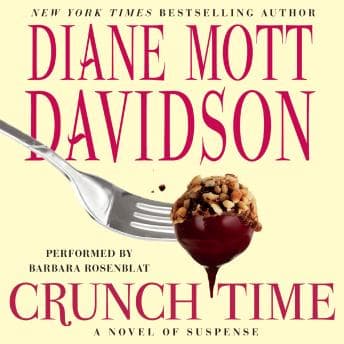

What happens when you combine Julia Child with Miss Marple and add nine beagle puppies for good measure?
I was grading a stack of sophomore essays on The Great Gatsby at 11:47 PM—you know the ones, where every third paper claims Nick Carraway is "relatable" without a shred of evidence—when I realized I needed something to keep me from writing increasingly sarcastic margin notes. Enter Diane Mott Davidson's Crunch Time, a culinary mystery that promised murder, mayhem, and recipes. The recipes, I should mention, are actually included. Denise has already bookmarked the cinnamon rolls.
The Literary Lineage of the Cozy Mystery
Here's the thing about culinary cozies that my more literary-minded colleagues tend to dismiss: they're working in a tradition as old as Agatha Christie herself. The amateur sleuth, the tight-knit community, the murder that disrupts domestic tranquility—this is formula, yes, but formula in the way that sonnets are formula. Brothers Karamazov works within its own constraints too; the Russian novel's sprawling family drama has rules as rigid as any cozy mystery, just with more existential dread and fewer puppies. The constraints are the point.
Goldy Schulz, our caterer-detective, operates in the same space as Miss Marple, except instead of knitting she's preparing hors d'oeuvres. Davidson understands that food is character development. The way Goldy stress-bakes, the way she feeds people through crisis, the way recipes punctuate the narrative like chapter breaks—it's all doing work that a lesser writer would accomplish through exposition dumps. When Goldy is kneading bread dough while processing a friend's murder, that's showing rather than telling. Song of Achilles does this brilliantly with Patroclus and his healing work—character development through action, not exposition. My AP English students could learn something here.
The plot itself is—and I'm being honest—a bit overstuffed. We've got arson, we've got murder, we've got those nine beagle puppies (which are not, as I initially suspected, a gimmick but actually integral to the mystery), and we've got enough suspects to populate a small Colorado town. Which, conveniently, is exactly what we have. By hour eight I was keeping a mental spreadsheet of who hated whom and why. This isn't necessarily a criticism. Some mysteries are meant to be untangled slowly, like Faulkner sentences but with more baked goods.
Barbara Rosenblat Knows When to Sprint
I listen to audiobooks at 1.0x because—as I tell my students who speed through SparkNotes—the author chose those words, and they deserve their proper rhythm. Barbara Rosenblat clearly agrees with me. Her pacing in Crunch Time is genuinely impressive, particularly during the suspense sequences. She understands that silence is punctuation. When things get dangerous, her tempo shifts, pulling you forward through scenes that might otherwise feel overwritten on the page.
What I appreciated most is her restraint. Rosenblat doesn't do theatrical voices for every character—she's not performing a one-woman show. Instead, she modulates tone and cadence just enough that you always know who's speaking without the narration becoming a distraction. Goldy sounds like a woman who's competent, harried, and genuinely kind. Her cop husband Tom sounds like a man who's tired of his wife finding bodies. (Fair.)
At sixteen hours, this is a commitment. But Rosenblat makes it feel like spending time with someone whose company you enjoy, even when the plot requires you to keep track of more threads than a Dickens novel.
Who Should Pour a Glass and Press Play
If you loved Murder, She Wrote—and I did, don't @ me—this is your jam. If you want something you can listen to while grading papers without missing crucial plot points every time a student writes "Fitzgerald's symbolism is very symbolic," this works. Skip it if you need your mysteries dark and your prose spare. Davidson writes in a voice that's warm, domestic, and unapologetically feminine in a genre that sometimes forgets women solved mysteries before they were allowed to vote.
My students would hate this. They want their entertainment fast and their protagonists morally grey. But I'm forty-seven years old, my back hurts, and sometimes I want a mystery where the detective also shares her recipe for chicken piccata. Sue me.
Worth Pausing the Faculty Meeting For
Is this literature with a capital L? No. Is it a well-crafted, genuinely entertaining audiobook that kept me company through three nights of essay grading? Absolutely. Davidson has been doing this for decades, and it shows—she knows her genre, respects her readers, and delivers exactly what she promises. Rosenblat's narration elevates solid source material into something genuinely pleasurable to listen to.
The puppies, by the way, survive. I know you were wondering. My students would call that a spoiler. I call it a public service.