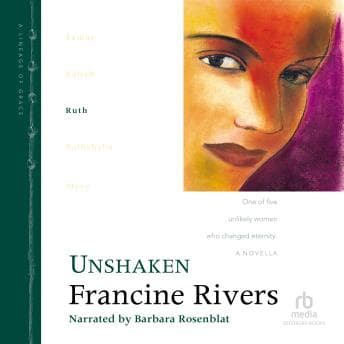

Denise and I were walking the lakefront last Saturday morning - one of those rare Chicago days in spring where the wind off the lake actually feels generous instead of hostile - and she asked me what I was listening to. When I told her it was a biblical retelling of the Book of Ruth, she gave me the look. You know the look. The "Marcus, you're an English teacher, not a pastor" look. But here's the thing: Francine Rivers isn't really writing a sermon. She's writing a quiet, devastating novel about displacement, loyalty, and the terrifying act of choosing love when every practical instinct tells you to walk away.
I finished it before we got home. At under six hours, Unshaken is compact, but Rivers uses that economy the way Hemingway used short sentences - every scene carries weight because there's nowhere to hide.
The Story of Ruth, But You Actually Feel the Dust Between Your Toes
Let's talk about what Rivers is really doing here. The biblical Ruth is four chapters. Four. Most people know the broad strokes: Naomi loses everything, Ruth refuses to leave her, Boaz is the good man who steps up. Rivers takes that skeleton and builds real human psychology around it. She gives Naomi a bitterness that borders on cruelty - not the sanitized grief you'd expect from inspirational fiction, but the kind of sharp-edged mourning that pushes people away. Ruth's devotion isn't portrayed as simple or saintly. Rivers writes it as a choice Ruth keeps making, day after day, even when Naomi makes it hard to stay.
And the relationship between Ruth and Boaz - Rivers builds it with patience. Their exchanges at the threshing floor carry genuine tension, not just romantic but social. Ruth is a Moabite woman in Bethlehem. She's an outsider. Rivers never lets you forget what that costs her, the sideways glances from other women gathering grain, the vulnerability of gleaning in fields where she has no legal protection. The prose deserves to be savored because Rivers trusts the small moments - a shared glance across a field, the weight of barley in Ruth's arms - to do the emotional heavy lifting.
My students would hate this. I love it.
Barbara Rosenblat Knows That Silence Is a Character Too
Barbara Rosenblat has won more AudioFile Earphones Awards than I've had hot dinners (well, fifty-plus, so maybe that tracks). She's earned the Golden Voice designation, and in this performance, you hear why. Her approach here is restraint. This isn't a book that calls for theatrical fireworks. Rosenblat gives Naomi a low, worn quality - the voice of a woman who's buried her husband and both sons and doesn't see the point of pretending she's fine. Ruth gets something softer but firm, a steadiness that contrasts with Naomi's brittleness.
The narrator understands that pause is punctuation. There are moments - particularly when Ruth makes her famous declaration to Naomi, "Where you go I will go" - where Rosenblat lets the silence after the words do as much work as the words themselves. She doesn't oversell it. She doesn't add a tremor to her voice or go breathy for emotional impact. She trusts the text. That's a rare skill.
I will say this: the research turned up almost zero complaints about the narration, which either means it's genuinely excellent or nobody who disliked it bothered to review. Based on what I heard, I'm betting on the former. But I'll be honest - at six hours, with a single narrator and standard production (no music, no sound effects, no full cast), this is an intimate, stripped-down listen. If you need audio fireworks to stay engaged, this isn't that.
Who This Is For (And Who Should Keep Walking)
If you loved Marilynne Robinson's Gilead - that same sense of faith lived in the bones rather than preached from a pulpit - this is its spiritual successor in audiobook form, albeit from a more explicitly Christian tradition. Rivers writes for believers, and that framework is present throughout. But the human story underneath - a refugee woman choosing loyalty over safety, an older man choosing integrity over convenience - that's universal.
Skip this if you want action, complexity of plot, or moral ambiguity. Rivers is working within a tradition where God provides, and if that framework frustrates you, the last hour will feel like a foregone conclusion. I ran into a similar situation with Into the Forest - a book that also asks you to surrender to its own internal logic, and either you do or you spend the whole time fighting it. But if you can meet the book on its own terms? There's genuine artistry here.
I listened at 1.0x, because the author chose those words. Denise listened to the last twenty minutes with me, sharing an earbud on a park bench. She didn't give me the look this time.
Worth Pausing the Faculty Meeting For
At just under six hours, Unshaken is a weekend listen - maybe a long afternoon if you're grading papers and need something that rewards attention without demanding constant focus. Rosenblat's performance elevates already strong source material, and Rivers proves that a familiar story, told with genuine emotional intelligence, still has the power to stop you mid-step on a lakefront path. This is why we still read the classics - even the ones people think they already know.