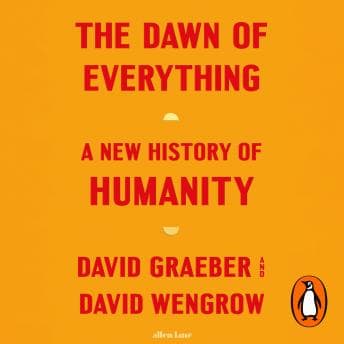

Look, I'm gonna start with a confession that might get my security clearance revoked: I spent 24 hours listening to two academics tell me everything I learned about human history is wrong. And I didn't hate it.
That's the thing about The Dawn of Everything. David Graeber and David Wengrow basically walk up to every textbook you ever read, flip it over, and say "Actually, no." Hunter-gatherers weren't simple. Agriculture wasn't inevitable. Cities didn't automatically mean kings and slaves. The whole Rousseau versus Hobbes debate about whether humans were born free or born violent? According to these guys, it's the wrong question entirely.
When Your Whole Worldview Gets a Debrief
I've read a lot of military history. Strategy, logistics, the rise and fall of empires - that's my wheelhouse. If you want to understand how power actually operates in those empires, 48 Laws of Power breaks down the mechanics in ways that would've saved me some headaches early in my career. But this book made me realize I'd been operating with some pretty lazy assumptions about how civilizations actually work. The authors dig into archaeological evidence from sites I'd never heard of - places like Çatalhöyük and Poverty Point - and show that ancient peoples were experimenting with different social structures all the time. Seasonal hierarchies. Cities without rulers. Farming communities that deliberately chose to stop farming.
The section on Indigenous critiques of European society hit different for me. Turns out, Enlightenment thinkers weren't just sitting around inventing democracy from scratch. They were responding to actual conversations with Native American intellectuals who were basically telling them their society was broken. That's not in most history books, and honestly, it should be.
Malk Williams Behind the Mic
Here's where I gotta be straight with you. Malk Williams does solid work. Clear enunciation, steady pacing - the guy's an Earphones Award winner for a reason. But some listeners have noted his delivery can feel a bit... jaunty? And yeah, I get it. When you're discussing the origins of slavery or the collapse of egalitarian societies, a cheerful tone can feel off.
Personally, I didn't mind it. After 25 years of briefings delivered in monotone by exhausted staff officers, a narrator with some energy is a nice change. Williams keeps the material moving, and with 24 hours of dense anthropological argument, you need someone who won't put you to sleep. I listened at 1.25x - my standard speed - and it worked fine. Maybe even helped smooth out some of that bounciness.
The Long Haul
Let me cut to the chase on the length. This is not a casual listen. I burned through it over about three weeks of driving between client sites, and there were moments - I won't lie - where I had to rewind because my brain wandered. The authors love their tangents. They'll be making a point about Mesopotamian city-states and suddenly you're getting a 20-minute sidebar about Amazonian flood-retreat farming.
But here's the thing: those tangents are often the best parts. Graeber and Wengrow aren't just making an argument. They're showing you how much weird, fascinating stuff got left out of the standard narrative. It's like they're saying, "You think you know history? Here's what else was happening."
Ranger sat through the whole thing with me. (He's heard worse - I made him endure a 40-hour series on the Pacific Theater last year.) I think he approved, though he did give me a look during the chapter on prehistoric European mega-sites. Fair enough, buddy.
Who's This Mission For?
Skip this if you want a straight narrative with clear heroes and villains, or if dense academic arguments make your eyes glaze over - grab the physical book instead so you can flip back and forth. But if you're the kind of person who likes having their assumptions challenged and you've got the patience for a 24-hour intellectual workout, this is worth the investment.
The authors clearly did their homework. I've seen enough sloppy research to know when someone's actually engaged with the evidence, and Graeber and Wengrow have. They're not just speculating. They're building a case, piece by piece, from archaeological digs and anthropological studies most of us have never encountered.
Did it change everything I think about human history? Not entirely. But it opened some doors I didn't know existed. And sometimes that's enough.
Mission accomplished. Mostly.