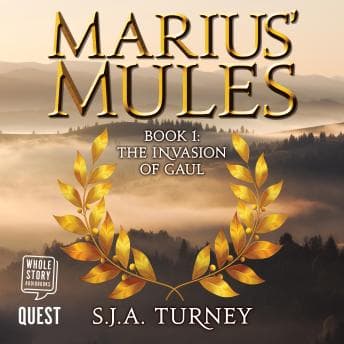

"Politics can be as dangerous as battle." That line hit me somewhere around hour three, and honestly? It's the thesis statement for this entire seventeen-hour journey through Caesar's early Gallic campaigns. I was grading sophomore essays on The Great Gatsby at the time—the irony of reading about one ambitious man while listening to another wasn't lost on me.
Look, I teach English, not history. But the classics are the classics because they keep circling back to the same human truths, and S.J.A. Turney gets that. This isn't just sword-and-sandal adventure fiction (though there's plenty of that). It's a meditation on what happens when good men stand too close to great ones.
When Caesar Enters the Room
Fronto is our guy here—career military, wants nothing to do with politics, just wants to command his legion and maybe survive long enough to retire somewhere warm. Sound familiar? He's basically every middle manager who ever said "I just want to do my job" before getting dragged into office drama. Except his office drama involves thousands of Gauls who'd really prefer not to be conquered.
Malk Williams narrates with these soft Northern English tones that took me by surprise at first. Roman soldiers with Yorkshire accents? But here's the thing—it works. The quietness of his delivery makes the battle scenes hit harder. He's not shouting at you. He's telling you a story the way a veteran might, sitting by a fire, voice low because some of these memories still sting.
The pacing is deliberate. This is a 17-hour commitment, and Turney isn't rushing. We get the political maneuvering, the camp life, the small moments between soldiers. My students would absolutely hate this. They'd call it slow. They'd want the battles faster, the plot tighter. And they'd be missing the point entirely—this is how you build a world that feels lived-in rather than staged.
The Blood and the Boredom
I should warn you: the battles get graphic. Progressively so. Turney doesn't shy away from what Roman military conquest actually looked like, and by the later chapters, we're deep in visceral territory. I found myself pausing during a particularly brutal siege description—not because I couldn't handle it, but because I needed to sit with what I'd just heard. That's good writing. Uncomfortable, but good.
Where the book stumbles—and I'm being honest here because you deserve that—is in its treatment of the Gauls. They're more obstacle than character. We get inside Roman heads beautifully, but the people being conquered remain largely faceless. It's historically authentic to the Roman perspective, sure. Caesar's own commentaries treated the Gauls the same way. But it left me wanting more. (This reminds me of what Hemingway said about the iceberg theory—except here, the submerged portion of the Gallic experience might be a little too submerged.)
Williams does what he can with the material. His Roman voices are distinct and memorable—I could tell Fronto from Longinus from Caesar without the dialogue tags. But when Gauls speak, there's less to work with. The narrator understands that pause is punctuation, and he uses silence beautifully in the political scenes. The military councils crackle with tension.
Worth Pausing the Faculty Meeting For
I listened to most of this during my morning walks along the lakefront, and there's something fitting about that. The rhythm of marching, the steady forward progress, the occasional stop to catch your breath before the next stretch. This is a book that rewards patience.
Is it perfect? No. The modern idioms that slip in occasionally pulled me out of ancient Gaul—there's a "that's just the vibe" quality to some dialogue that feels anachronistic. And if you're looking for deep psychological complexity in every character, you'll be frustrated. Fronto is well-drawn, Caesar is compelling, but the supporting cast can blur together.
But here's what I kept thinking: this is the first book in a long series. Turney is laying groundwork. He's building something. And Williams is the right voice to build it with—professional, clean production, a narrator who clearly understands military fiction and doesn't oversell the drama.
If you loved Conn Iggulden's Emperor series, this is its spiritual successor. The same tension between personal ambition and moral consequence drives Rich People Problems, though the stakes there involve family empires instead of actual ones. If you've ever wondered what it actually felt like to be a Roman officer caught between loyalty and conscience, Turney has answers. And if you've got a long commute and seventeen hours to fill? You could do much worse.
Who's This For (And Who Should Run)
Listen if you want slow-burn military historical fiction with political teeth—the kind that rewards patience and doesn't insult your intelligence. Skip if you need constant action, can't handle graphic battle violence, or want equal time given to the conquered peoples' perspective.
My students would hate this. I love it. That's probably all you need to know.