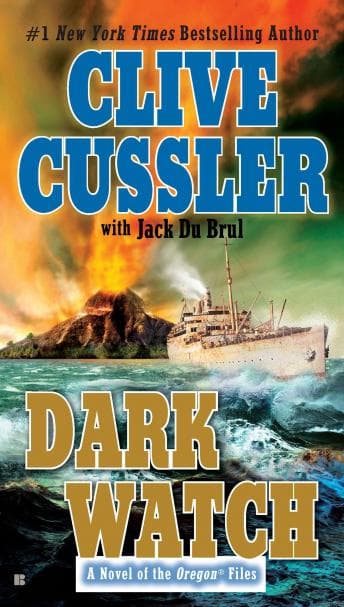

What happens when you take a spy ship that looks like it belongs in a scrapyard, stuff it with enough hidden firepower to make a Bond villain jealous, and throw it against modern-day pirates? You get Dark Watch, and honestly, it scratches the same itch as rolling a natural 20 on a naval combat encounter.
I queued this up for a solo road trip through the Midwest, figuring twelve hours of maritime adventure would keep me company through the corn. And look—it worked. There's something about Cussler's formula that just pairs with long stretches of highway, the same way a good dungeon crawl pairs with pizza and Mountain Dew.
The Campaign Hook
The setup is pure adventure module material: Juan Cabrillo and his crew of specialists operate the Oregon, a spy ship disguised as a rusting heap that's actually packing serious heat beneath the surface. Japanese shipping magnates hire them to deal with pirates terrorizing Southeast Asian waters. Simple enough, right? Except the piracy turns out to be a front for something much nastier—human trafficking and an international conspiracy that goes way deeper than anyone expected. It's like starting what you think is a straightforward combat encounter and realizing halfway through that you've stumbled into the campaign's main villain arc.
Scott Brick: Veteran DM Energy
Scott Brick is the narrator here, and the man is basically the equivalent of a veteran DM who knows exactly when to lower his voice for dramatic effect. He brings that same commanding energy to Jurassic Park, where the tension ratchets up just as effectively. His pacing during action sequences is genuinely impressive—he accelerates through combat, holds tension during standoffs, and gives Cabrillo this commanding presence without going full cartoon. One listener nailed it: "His volume and pitch match the ever increasing tension as Cabrillo passes information to the U.S." That's not just reading. That's performance.
Now, I gotta be honest about something that kept pulling me out of the immersion. Brick's dialect work for certain Asian characters? It's rough. Like, "the bard rolled a 3 on their performance check" rough. Multiple listeners called this out, and they're not wrong. It's not catastrophic, but it's noticeable enough that you might wince during otherwise solid scenes. There's also this thing where he apparently mispronounces "helo"—short for helicopter—throughout the book. Once you clock it, you can't un-hear it. Minor stuff, but the kind of detail that nags at you.
Mid-Campaign Solid, Not the Final Boss
The story itself lands somewhere in the middle of the Oregon Files series. Not the crown jewel, not the forgettable one-shot. The piracy angle gives Brick plenty of opportunities to flex during naval combat and tactical operations, and he clearly relishes those moments. Where things get interesting is how Cussler and Du Brul handle the human trafficking subplot. This isn't just window dressing—there's genuine anger in how they depict it, and that anger comes through in Brick's delivery. It gives the pulpy action some actual weight, like when a campaign suddenly gets serious and everyone at the table sits up straighter.
Fair warning: this one runs hotter than typical Cussler. More explicit violence, stronger language, and a few sex scenes that feel like someone decided to add romance subplots to what was working fine as a tactical thriller. Some listeners found these distracting, and I get it. It's like when someone insists on adding unnecessary roleplay elements to what should be a straightforward heist.
The Oregon: Basically a Mimic That Eats Pirates
The Oregon itself remains one of my favorite conceits in adventure fiction. A ship that looks condemned but hides state-of-the-art everything? It's basically a mimic, except instead of eating adventurers, it eats pirates. That same sense of hidden complexity—things being more than they appear—is what makes Second Foundation so satisfying, even if we're trading naval combat for psychohistory. Brick clearly enjoys describing its hidden capabilities, and his enthusiasm is infectious.
Production quality is clean—no background noise, consistent levels, professional editing throughout. At twelve and a half hours, it's a substantial listen without dragging. I finished my drive faster than expected, which is the audiobook equivalent of "I didn't notice time passing during the session."
Who's This Adventure For?
For series fans, this is essential. For newcomers, you can jump in here without too much confusion—the core plot stands alone, even if you'll miss some character backstory. The audiobook format genuinely enhances the experience; Brick's dramatic delivery during combat adds a visceral punch that silent reading might not capture.
A few things to consider before committing: if imperfect dialects or mispronunciations break your immersion, sample first. If you're sensitive to violence, sexual content, or strong language, know that this entry pushes further than some Cussler books. And if you're looking for literary depth? You've wandered into the wrong genre entirely—this is popcorn entertainment with professional polish.
Roll for Initiative
But as popcorn entertainment? Dark Watch delivers. Brick remains one of the best voices in action-adventure audiobooks, and even with the rough edges, his performance elevates solid source material into an engaging listen. Those highway miles disappeared, and that's the best endorsement I can give.