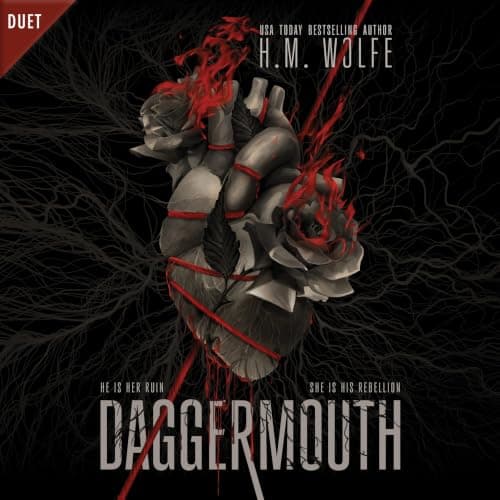

Daggermouth is a sale buy for me: the failed-assassin-turned-bride setup earns my attention, but the surveillance state interests me more than the promise of two dangerous people wanting each other dead—or in bed.
I had it on while checking Jamal’s multiplication homework at the kitchen table, after he’d gone back to fix the same problem twice. The idea of a city deciding who gets to love whom landed harder in that ordinary little pocket of the evening. My boys already ask why some neighborhoods get more than others. New Found Haven takes that question and makes the answer government policy. Ugly business.
That’s the hook worth considering before you commit to 18 hours and 11 minutes. You’re buying a dark romance inside a system of enforced inequality, not a straight assassination thriller with an incidental relationship.
A missed bullet becomes a marriage contract
Shadera Kael tries to kill Greyson Serel, the president’s son. She fails, and survival means marrying her intended target. That isn’t a minor misunderstanding waiting for a heartfelt conversation. She entered his life with a lethal objective; he represents the machinery keeping her trapped. The hostility has an actual foundation.
The marriage is also where my practical questions start. A regime turning an assassination attempt into a political union needs reasons stronger than keeping two attractive enemies in the same room. The supplied material establishes the marriage as a means of control, but doesn’t give enough scene-level evidence to judge every step of that political calculation. I’m not going to invent a clever explanation on Wolfe’s behalf.
What does work as a premise is the unequal captivity. Greyson has presidential blood and a polished public identity, yet his private secrets threaten the government. Shadera has lethal training, but being capable of killing someone doesn’t mean she can walk out of a watched building. Different kinds of leverage. Different kinds of cage.
And the geography matters. The Heart has its glass atriums; the Boundary has windowless slums. Love across the city’s rings can earn a death sentence, while the Veyra keep watch. Those aren’t just gloomy decorations. Housing, visibility, marriage—basic parts of living become tools for sorting people into acceptable and disposable.
That’s what gets under my skin. Still, a divided city isn’t automatically a convincing portrait of the people doing its work. The available details center the mercenary and the presidential heir. I wouldn’t sell this as a working-class rebellion story without stronger evidence that ordinary residents get more than suffering in the background.
Two performers aren’t the same as a whole city
Teddy Hamilton and Angel Pean perform Daggermouth in duet. That distinction matters if you’re choosing the audiobook specifically for the relationship: the format supports exchanges between performers rather than relying entirely on a new narrator taking over at each viewpoint change.
The audio-specific feedback is mostly encouraging. Listeners praise their partnership and describe the darker material as having added grit and weight. But there are two useful cautions hiding beneath that enthusiasm.
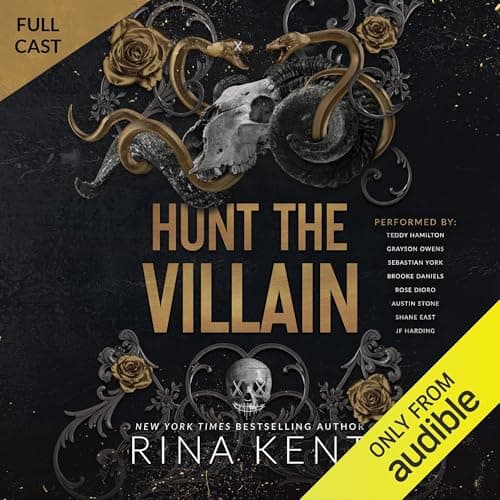
One listener found Pean’s enunciation too pronounced. Another wanted a larger cast for the number of viewpoints. Those are separate concerns: sharply articulated delivery might bother your ear, while two performers covering a wider perspective roster might make you work harder to keep people straight. That concern makes the full-cast setup of Hunt the Villain look practical rather than flashy to me. Neither complaint proves the recording is bad. Both make the sample button worth using. Teddy Hamilton also pairs with Jennifer Stark on The Last Letter, but I would still sample this one on its own terms because Pean's delivery is the variable here.
I normally push playback to 1.6x because my free time comes in scraps. For this one, I’d start closer to 1.25x and check how Pean’s articulation lands before speeding up. That’s a practical suggestion, not a claim that I tested every setting. At 1.6x, the listed runtime works out to roughly eleven hours and twenty-two minutes—still a substantial commitment.
There’s no supplied evidence about effects, music, or editing defects, so I’m not handing out production praise for things nobody documented.
Sample Pean before you spend the credit
Pick Daggermouth if you want an attempted killing to remain the foundation of a romance, with marriage functioning as political restraint rather than safety. You also need an appetite for surveillance, brutal laws, and a relationship developing under coercive circumstances. Not my choice for listening aloud with the kids nearby.
Skip it if your main requirement is a rigorously demonstrated security apparatus or an ensemble supported by a large voice cast. The available evidence doesn’t justify promising either. And this is book one, not a purchase I’d make on the assumption that every revolutionary thread gets settled here.
The Heart and Boundary give me a reason to care; Shadera’s marriage gives me a reason to be suspicious. That combination earns a sample and a sale purchase. Full-price confidence? Not quite.