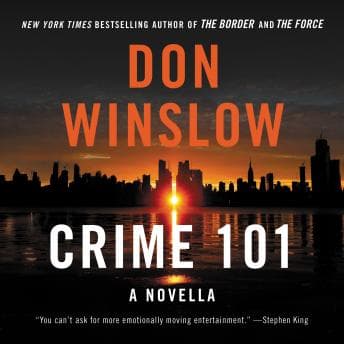

Look, I have a bone to pick with Don Winslow. Two hours and five minutes? That's it? I was halfway through prepping a chicken biryani — onions caramelizing, whole spices blooming in oil, the kitchen smelling like my mother's house in Edison — and this novella had the audacity to end before my rice was even soaking. I stood there with a wooden spoon in one hand and my phone in the other, genuinely irritated. Not because it was bad. Because it was over.
And that's the problem with Crime 101. It's the literary equivalent of a perfect heist: in, out, no wasted moves, and you're left standing there wondering what just happened.
The Psychology of a Man Who Won't Quit
Here's what got me. The unnamed jewel thief — and the fact that Winslow keeps him unnamed for most of this is a deliberate psychological move — operates by a strict internal code. Crime 101. Rules he's built to keep himself alive and free. Don't get greedy. Don't work with anyone. Don't deviate from the plan. The research actually shows that people who construct rigid personal rule systems like this are often managing deep anxiety through the illusion of control. And Winslow gets that. This isn't just a cool criminal with a code. This is a man who has systematized his entire existence because the alternative — chaos, vulnerability, connection — terrifies him.
So naturally, the story is about what happens when those rules start cracking.
I found myself asking: why does this guy really want one last score? He says it's the money. He says it's the exit strategy. But Winslow writes him as someone who's been alone on the Pacific Coast Highway for years, living in motels, eating alone (I relate to this more than I should), and the "final job" isn't about retirement. It's about meaning. The protagonist exhibits classic approach-avoidance conflict — he wants out, but the code is his identity. Remove it, and who is he?
That's good character work for two hours. That's great character work for two hours.
Detective Lubesnick and the Gut That Won't Shut Up
The flip side is Lou Lubesnick, the detective who's convinced these heists are one person while everyone else blames Colombian cartels. And this is a fascinating case study in institutional versus individual cognition. The system defaults to the big, dramatic explanation — organized crime, international conspiracy — because that's the narrative that justifies budgets and task forces. Lou's gut says it's simpler. One guy. One code. One pattern.
Psychologically, this tracks perfectly. Lou is doing what good detectives and good psychologists do: he's reading behavior, not story. He's ignoring the narrative everyone's selling and watching the actual data. The heists are too clean, too consistent, too disciplined for a cartel operation. Cartels are organizations; organizations have variability. This has none. One mind. One set of rules.
My therapist would have thoughts about Lou, too — a man so obsessed with proving his theory that he starts breaking his own professional code. Mirror image of the thief. Both men defined by their rules, both men undone when those rules bend. That particular psychological trap — identity fused so completely with a personal code that breaking the rule means breaking the self — is something I kept turning over while reading Gone Too Deep, which does something similarly compelling with a man whose survival instincts become the very thing isolating him from everyone worth surviving for.
Ray Porter Does the Thing
Ray Porter narrates, and I'll be honest — my research on this performance came up frustratingly vague. Everyone says "fantastic" and "captivating" without telling me how. So here's what I can tell you from my own ears: Porter is a single narrator carrying what is essentially a two-hander between a thief and a cop, and he does it with tonal shifts rather than dramatic voice changes. The thief's sections are quieter, more internal, almost meditative. Lou's sections have more edge, more friction. It's subtle. It works. For a two-hour novella, you don't need theatrical range — you need someone who can make stripped-down prose feel lived-in, and Porter does that.
The pacing is tight. Like, really tight. Winslow writes short, punchy chapters that feel almost cinematic (apparently this is being made into a movie with Chris Hemsworth, Mark Ruffalo, and Halle Berry, which — I have questions about the casting but that's a different review). At 1x speed, it clips along perfectly. Don't speed this up. You'll miss the rhythm, and the rhythm is the point.
Who Gets the Most Out of This
If you want a 400-page procedural with twelve subplots and a romantic interest, this isn't it. Skip it. If you want a lean, smart crime novella that understands why people build cages for themselves and call them codes — come sit with me.
Thrillers fans who appreciate economy. People who think the best heist stories are really character studies. Anyone who's ever made a rigid rule for themselves and then watched it crack under pressure. (So... everyone in therapy, basically.)
My Clinical Assessment
Two hours. Two men. One code that was always going to break. I finished it, turned off my earbuds, and realized my onions had burned. Worth it. But Winslow, you owe me an onion.