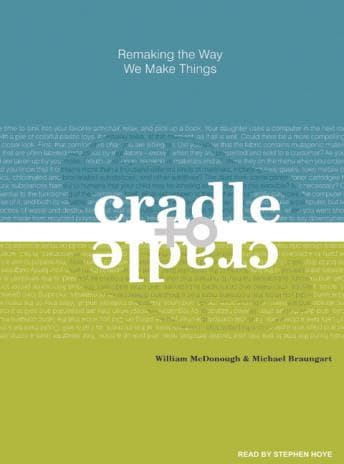

"Waste equals food."
That line hit me somewhere around mile marker 23 on the Caltrain, and I actually paused the audiobook to think about it. Which, if you know me, is saying something—I basically never pause anything. But here's the thing: Cradle to Cradle isn't just another "recycle more, feel guilty about your plastic bags" book. It's actually a systems design book wearing an environmentalism costume. And as someone who spends her days thinking about distributed systems, that framing clicked hard.
Bottom Line: Worth your commute if you're into design thinking and sustainability, but the authors really, really want you to know how smart they are.
The Framework That Actually Makes Sense
So the core argument is basically this: our entire manufacturing model is broken at the architecture level. We're not going to optimize our way out of environmental disaster by recycling more—that's just making the same bad system slightly less bad. McDonough and Braungart want you to think about products the way nature thinks about a cherry tree. The tree doesn't "waste" anything—the blossoms that fall become nutrients for the soil. Why can't a carpet do that?
They break materials into two categories: biological nutrients (stuff that can safely decompose back into nature) and technical nutrients (materials that should stay in closed industrial loops forever, never downgraded, never landfilled). It's elegant. It's the kind of framework that makes you look at every object in your apartment differently.
I finished this in about 4 commutes, and honestly? The first two hours are gold. The concepts are genuinely novel—at least they were when this was written, and they still hold up. The science actually holds up, which I appreciate. These guys aren't just hand-waving about "being green." They've redesigned actual products, actual buildings. There's credibility here.
Where It Gets... A Lot
Okay, so here's where I have to be honest. The authors have a bit of a... confidence problem? Like, they really want you to know about every brilliant thing they've ever done. Every project. Every client who was amazed by their genius. By hour three, I started playing a mental drinking game every time they mentioned a prestigious project they'd worked on. (Don't actually do this. You'd be wasted by the time you hit your stop.)
The writing gets repetitive too. Once you've grasped the core framework—which takes maybe 90 minutes—they just... keep explaining it. Different examples, same point. I bumped it up to 1.75x for the back half, which helped. Could've been a blog post? No, that's too harsh. But it could've been a tighter 3.5 hours, easy.
Stephen Hoye Does the Heavy Lifting
The narrator situation is interesting. Stephen Hoye has won like fifteen AudioFile Earphones Awards, so the guy knows what he's doing. His delivery is clear—really clear—which matters when you're dealing with conceptual material at 6AM surrounded by snoring commuters. The pacing is solid for absorption.
But. (There's always a but.) He's got this slightly singsong quality that some listeners find annoying. I noticed it but didn't hate it? It kind of matches the slightly professorial tone of the writing, honestly. If the authors are going to sound a little high-brow and self-congratulatory, having a narrator who leans into that polish makes sense. Your mileage may vary.
Production quality is clean. No complaints there.
Who Should Queue This Up (And Who Should Skip)
Perfect for: train, long walks. Skip for: gym (too conceptual to follow while you're dying on the treadmill).
This is basically design thinking but for sustainability. If you're in product development, manufacturing, architecture, or honestly any field where you make physical things—the ROI on this audiobook is pretty high. Business school types, this should be required listening. The framework alone is worth the 5.5 hours. If you're more interested in how systems track and control behavior at scale, Data and Goliath applies similar systems thinking to the surveillance economy.
But if you're looking for practical tips on how to live more sustainably in your daily life? This ain't it. This is big-picture industrial design philosophy. Important, yes. Actionable for the average person? Not really. Skip this one if you want a how-to guide for greening your household.
Also—and this is worth noting—the book is pretty visual in concept. They talk about specific products, specific designs. I found myself wishing I could see diagrams a few times. If you're a really visual thinker, you might want the physical book instead.
Cached for Future Reference?
Probably won't listen to the whole thing again. But I've already referenced the biological/technical nutrients framework in like three conversations since finishing it. The core ideas are sticky. They change how you see manufactured objects. That's worth something.
Just... maybe have your finger on the skip-forward button for when they start talking about how amazing their carpet redesign was. Again.






![Steve Jobs [unabridged audiobook] audiobook cover](/_next/image?url=https%3A%2F%2Fcovers.audiobooks.com%2Fimages%2Fcovers%2Ffull%2F9788499923406.jpg&w=1920&q=75)