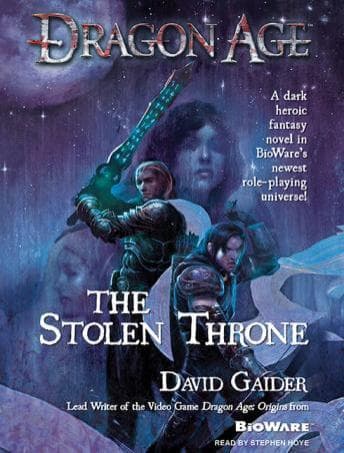

Dragon Age: The Stolen Throne is a video game tie-in novel that actually tries to be a real book. And mostly succeeds. Mostly.
I knocked this one out over a week of client site visits across central Texas - long stretches of highway between Austin and San Antonio, Ranger riding shotgun with his head out the window while I absorbed thirteen hours of medieval political rebellion. The setting fit. There's something about flat Texas highway at dusk that pairs well with a young prince running for his life through hostile territory.
A Prince Who Earns His Scars
Let me cut to the chase: Maric starts this book as a kid who has no business leading anyone. His mother - the Rebel Queen - gets murdered by treacherous nobles, and suddenly he's supposed to rally an insurgency against an occupying foreign power. David Gaider, who was the lead writer on the Dragon Age games at BioWare, clearly understands that leadership isn't inherited - it's forged. And he takes his time forging Maric.
The triangle between Maric, Loghain, and Rowan is where the book actually has teeth. Loghain is the cynical outlaw who saved Maric's life and can't quite figure out why he keeps following this idealistic kid. Rowan is the warrior promised to Maric since birth, which should feel like a tired trope, but Gaider gives her enough edge that she doesn't just stand around waiting to be relevant. She fights. She questions. She makes hard calls.
I've seen this scenario play out in real life - young officers thrust into command positions they haven't earned yet, surrounded by NCOs and senior enlisted who've been doing the job for years. The tension between positional authority and actual competence is real, and Gaider gets that dynamic right. The Brothers Karamazov puts that same pressure on its characters from a completely different angle - men constantly measuring each other's moral authority against their actual choices, and it hit me somewhere similar. Brothers Karamazov has no fantasy armor, but the political calculus between those brothers felt just as unforgiving. Maric's commanders don't trust him. His allies are constantly calculating whether he's worth the investment. That political calculus felt authentic even wrapped in fantasy armor.
What didn't work as well: the pacing. This is a slow burn, and I mean slow. The middle third of the book drags through political maneuvering that could've been tightened by two or three hours without losing anything critical. At 13 hours and change, you feel every minute of the setup before things start moving.
Stephen Hoye's Deep Command Voice (With One Caveat)
Stephen Hoye has this deep, authoritative delivery that sounds like a general briefing the room before a major operation. For Maric's scenes - especially as the character grows from uncertain boy to something resembling a real leader - that voice works beautifully. You can hear the shift in Hoye's tone as Maric hardens. It's subtle work.
But here's the thing: that same steady, forceful pacing that sells the battle scenes and political confrontations also slows the quieter moments to a crawl. Hoye doesn't shift gears enough between action and downtime. A tense ambush and a conversation around a campfire get roughly the same deliberate cadence, and after a few hours your brain starts wanting more variation.
I listened at my usual 1.25x and it helped. Some folks recommend bumping to 1.5x, but I think that's overcorrecting - you'd lose some of the emotional weight Hoye puts into Maric's growth moments. Split the difference at 1.25x and you're in the sweet spot.
The BioWare Writer Problem
Gaider knows how to build a world and populate it with characters who have actual motivations. That's his job at BioWare, and it shows. The political landscape of Ferelden - occupied nation, fractured resistance, noble houses playing all sides - feels lived in. If you've played Dragon Age: Origins, this is the backstory you always wanted. If you haven't played the games, it still works as a standalone fantasy rebellion story, though you'll miss some of the "oh, so THAT'S why" moments.
The problem is Gaider also writes like a game designer sometimes. Characters occasionally deliver exposition the way an NPC would - a little too neatly, a little too conveniently. The plot hits some predictable beats that any fantasy reader will see coming from a mile out. The betrayals aren't surprising enough. When you're writing about a world of spies and traitors, I need at least one gut-punch I didn't see coming. This book plays it safe.
But when it works - and the last third genuinely works - there's real weight to the action. The cost of rebellion isn't glossed over. People die badly. Leadership means sending friends to their deaths. That part Gaider nails.
Worth Your Time? Here's the Debrief
If you're a Dragon Age fan, this is essential reading. Period. The backstory enriches the games enormously. If you're coming in cold, it's a decent fantasy rebellion story with a strong central character arc and a narrator who brings real authority to the performance - just be prepared for a slow burn that tests your patience before paying off.
Ranger slept through the quiet parts but perked up for the battles. I trust his instincts.
Worth a credit? If you're in the Dragon Age universe, absolutely. If not, maybe wait for a sale and bump that speed up a notch.