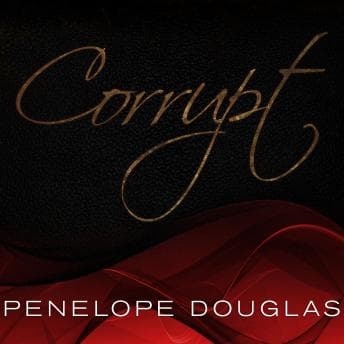

I need to be upfront about something: I'm a high school English teacher who spends his days trying to convince teenagers that Austen is actually romantic. So when I tell you I listened to fourteen hours of dark romance where the love interest literally orchestrates revenge against the heroine? My students would have a field day with that.
But here's the thing about Penelope Douglas's Corrupt - it's not trying to be Austen. It's not even trying to be respectable. And there's something almost refreshing about a book that knows exactly what it is and commits fully to being that thing. Promise has that same unapologetic energy, though it leans more into the emotional devastation than the revenge angle.
The Dual Voice Problem
Let's talk about Jeremy York and Tatiana Sokolov, because the narration situation here is... complicated. York has this clear, somewhat gentle voice that works beautifully for certain characters. The problem? Michael Crist is supposed to be a menacing pro basketball player with a vendetta. You can feel the disconnect. It's like casting a romantic lead to play the villain - technically competent, but the energy is off.
Sokolov handles Rika with more success, though I'll be honest - I've seen listener reviews calling her voice "annoying" and I don't entirely disagree. There's a breathiness to some of her delivery that grated on me during the first few chapters. But here's where I'll defend her: she grows into the role. By the time Rika starts finding her backbone, Sokolov's performance clicks into place. The emotional delivery during the heavier scenes is genuinely affecting.
The dual narration itself is the saving grace. Getting both perspectives - predator and prey, though those roles blur considerably - adds layers that a single narrator couldn't achieve. When Michael's chapters reveal his obsession and Rika's reveal her fear transforming into something else entirely, the contrast hits differently than it would on the page.
Where Douglas Gets Under Your Skin
I teach literature. I analyze craft for a living. And I have to admit that Douglas understands something fundamental about tension that many "literary" authors don't: the slow burn works because she earns it.
The setup - Rika's testimony sent Michael's friends to prison, now they're out and she's alone in his city - is pure pulp. I wouldn't assign this in class. (Don't tell my students I said that.) But the execution is surprisingly patient. Douglas doesn't rush to the revenge. She lets the dread build. She lets you sit in Rika's fear and Michael's calculation until you're genuinely unsettled.
And then she does something clever. She starts revealing what actually happened three years ago. The story you think you're getting isn't the story you're getting. My Brilliant Friend does something similar with its dual timeline structure, though with considerably less revenge plotting and more Italian neighborhood politics. My students would recognize this as unreliable narration - they'd probably analyze it better than they analyze The Great Gatsby, honestly.
The content warnings are real, by the way. Violence, abuse, explicit sexual content, dark themes throughout. This isn't a book that flinches. If you're sensitive to any of that, this genuinely isn't for you, and that's completely valid.
Fourteen Hours of Grading Escape
I finished this during a week of grading senior essays on Hamlet. The irony of switching between "analyze the ghost's role in Hamlet's moral development" and a dark romance about masked men isn't lost on me. But honestly? After reading forty variations of the same thesis statement, there's something almost therapeutic about a book that's purely, unapologetically about desire and danger and the messy places where they intersect.
At 14 hours and 39 minutes, it's a commitment. The pacing drags in the middle - there's a stretch around hour seven where I found myself checking how much was left. But when the plot kicks back into gear, it moves. The production quality is clean, no audio issues to speak of.
Would I recommend speeding it up? Maybe to 1.1x during the slower sections. But Douglas writes with a rhythm that benefits from normal pacing during the intense moments. The pauses matter.
Mr. Williams's After-Hours Confession
Here's my honest take: Corrupt is not a book I'd recommend to everyone. It's not even a book I'd admit to my colleagues I listened to. But for what it is - dark romance with genuine psychological complexity and a narrator situation that's imperfect but functional - it works.
If you're already a fan of this genre, you probably don't need my permission. If you're curious but hesitant, sample the first chapter and trust your gut. If the narration voices click for you, you'll likely enjoy the ride. If they don't, the story probably won't save it. Skip this one if you need likeable characters or if the content warnings give you pause - Douglas doesn't soften any of it.
My students would hate this. I didn't hate it. That's the best endorsement I can give.