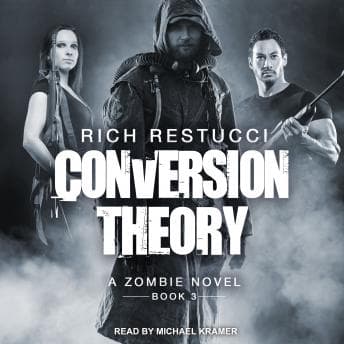

"He is now an utter badass who continually makes mistakes."
That line from the book description? That's the whole psychological thesis of this audiobook right there. I was chopping onions for a chana masala at 9 PM on a Tuesday - already emotionally compromised, eyes watering - when this line landed and I actually laughed out loud in my empty kitchen. Because Rich Restucci understands something fundamental about how people construct identity under extreme stress: we narrate ourselves into heroes while the evidence suggests otherwise. The protagonist exhibits classic self-enhancement bias, and the fact that Restucci makes this the joke rather than the blind spot is what separates this from a hundred other zombie survival stories.
The Narcissist's Guide to Surviving the Apocalypse
So here's the setup: one guy, immune to the zombie plague, telling his own story in first person while every major power structure left on Earth wants a piece of him. Government scientists, the undead, random hostile survivors - the usual post-apocalyptic welcome wagon. What makes this character compelling is not his immunity. It's his voice. He's an unreliable narrator in the best way - not because he's lying to you, but because his self-perception is hilariously skewed. Danny Torrance in Doctor Sleep works from a similarly distorted self-image - a man who has spent decades narrating himself as damaged beyond repair, only to find that self-story slowly, painfully revising under pressure. He'll describe himself making objectively terrible tactical decisions with the confidence of someone who just graduated from special forces training. The humor is baked into the cognitive dissonance between who he thinks he is and who he actually is.
But - and this is where I found myself asking: why does this character really work? - there's genuine growth underneath the bravado. The title, Conversion Theory, isn't just about zombies. It's about the conversion of identity. From "useless plebe" (his words) to someone capable of survival, even if that capability comes wrapped in self-deprecating humor and a startling number of mistakes. The research actually shows that humor is one of the most effective psychological coping mechanisms in high-threat environments. This protagonist isn't just being funny for the reader's benefit. He's keeping himself sane.
Now, the content warning I need to flag: the protagonist's humor includes racist and sexist jokes. The book frames this as "just who he is" - part of the character's voice, not the author's endorsement. But psychologically, this doesn't track as neatly as the book wants it to. There's a difference between a character having problematic views that the narrative interrogates and a character having problematic views that the narrative shrugs at. I'm not telling you what to do with that information. I'm just telling you it's there.
Michael Kramer, Alone in a Room With One Man's Brain
Here's the thing about first-person zombie apocalypse audiobooks: you're essentially trapped inside one skull for ten and a half hours. No ensemble cast to break the monotony. No alternating POVs. Just one voice, one perspective, one guy's running commentary on the end of the world. Michael Kramer has to carry this entirely on tone and timing.
And he does. Mostly.
Kramer captures the protagonist's particular brand of gallows humor - that flat delivery where you're not sure if the character is joking or genuinely delusional about his own competence. It took me about forty minutes to fully settle into it. For a while I kept thinking the protagonist was too cavalier, too detached, and I was mentally writing my "psychologically this doesn't track" note. Then something shifted. Kramer found the rhythm of the character's defense mechanisms, and suddenly I wasn't listening to narration anymore. I was listening to a guy who processes terror through sarcasm because the alternative is collapse. That's a real thing. My therapist would have thoughts about this character, and most of them would be about avoidance strategies.
The lack of distinct character voices is notable but not a dealbreaker. Since everything filters through the protagonist's first-person perspective, other characters are essentially his impressions of other characters. Which is actually more psychologically honest than giving everyone their own accent. We don't hear other people objectively. We hear them through our own filters.
Who This Is Actually For (And Who Should Run)
If you want zombie fiction that takes itself dead seriously - pun intended, I'm not sorry - this isn't it. If you need polished, inoffensive humor, skip this one. The protagonist's brand of comedy will either land for you or actively repel you, and I think you'll know within the first hour which camp you're in.
But if you're the kind of person who finds the psychology of survival fascinating - how people construct meaning, maintain identity, and cope through humor when everything has fallen apart - this is a surprisingly rich case study wrapped in genre fiction. I listened to most of it during a long Saturday cooking session and a Sunday morning jog through Cambridge, and the pacing held for both. Red Room has a similar sustained-dread energy that holds up across a full day's listening - though its humor is considerably darker and the narrator offers you far less psychological cushioning. It's not rushing anywhere, but it doesn't drag either.
The Case File, Closed
Rich Restucci is a chemist by trade, and there's something chemist-like about how this book works. Mix humor with horror, add an unreliable first-person narrator, apply heat. See what converts. The result isn't perfect - the character's offensive humor is a real barrier, and ten hours is a lot of time to spend inside one imperfect head. But the psychological honesty underneath the jokes? That part is real. And at 1.25x speed, the timing on the humor actually tightens up nicely.
Seven out of ten on the "would recommend to my dissertation committee" scale. They still wouldn't read it. But they'd understand why I did.