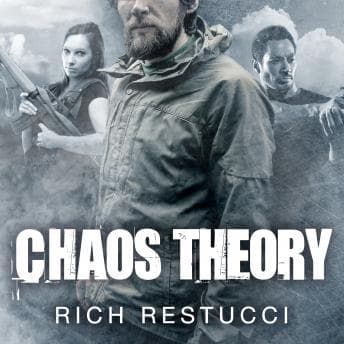

What happens when you hand Michael Kramer - the voice of Dalinar Kholin, the man who narrated the entire Wheel of Time - a zombie apocalypse novel with a wise-cracking protagonist? Do you get something transcendent, or does the mismatch implode?
I was up way too late on a Tuesday, ostensibly debugging a procedural terrain generator that kept spawning mountains inside lakes. (Dr. Patel would be so proud.) But I'd been running Chaos Theory in the background for like three hours and at some point I just... stopped coding. Sat there in my desk chair with cold ramen, grinning at my monitor like an idiot while a chemist-turned-author fed me zombie apocalypse snark through Michael Kramer's vocal cords.
The Sarcasm Engine That Runs on Undead Fuel
Here's the pitch: unnamed narrator dude survives the zombie apocalypse primarily through being a smartass. He teams up with a genius survivalist and a teenage girl, and they navigate the standard post-apocalyptic gauntlet - undead hordes, evil humans, people who want to exploit them. You've seen this setup before. You've probably played this campaign before. (My D&D group literally ran a zombie survival arc last semester. Our bard also survived mostly on wit. He died in session four.)
But Rich Restucci does something interesting with the formula. The protagonist's humor isn't just flavor text sprinkled on top of a grim survival story - it IS the survival story. His pithy remarks and constant internal monologue are the mechanism by which he processes a world that's gone completely sideways. It's less "action hero with quips" and more "guy who will literally die if he stops being funny because the alternative is psychological collapse." That distinction matters, and it's what kept me listening past the point where I should've been sleeping.
The problem? At seven hours, the sarcasm-to-sincerity ratio is... aggressive. Some listeners have described it as "one run-on sentence of sarcasm," and honestly, I get that. There are stretches where the wit becomes wallpaper - you stop noticing individual jokes because the entire texture is joke. It's like if your DM narrated every single thing in a sardonic tone, including the moments that should hit harder emotionally. By hour five I wanted the book to just... breathe for a second. Let a quiet moment land without undercutting it.
Kramer Playing Against Type (And Mostly Winning)
So here's the comparison that matters: if you know Michael Kramer from Sanderson or Jordan, you know him as the guy who can carry epic gravitas across forty-plus hours without breaking a sweat. Chaos Theory is the opposite end of the spectrum. Seven hours. Fast and mean and funny. And Kramer's comic timing is genuinely surprising - he lands the protagonist's deadpan delivery with this dry precision that I didn't know he had in his range. His voice for the main character has this exhausted, seen-too-much edge that works perfectly for a guy cracking jokes at the end of the world.
Where it gets dicier: because the book is so relentlessly sarcastic in its narration, Kramer's delivery can start to feel one-note even though it's technically excellent. Some folks have said it comes across as "overly sarcastic and tiring," and I think that's less a Kramer problem and more a source material problem. He's doing exactly what the text asks him to do. It's just that the text asks him to do the same thing for seven straight hours.
The character differentiation is solid - you can tell who's talking without the "he said / she said" tags, which is basically the minimum bar but you'd be amazed how many narrators can't clear it. The survivalist and the teenage girl each get their own vocal register. Nothing as dramatic as what Kramer does with, say, Shallan versus Kaladin, but this is a tighter cast and a tighter story.
Who's Rolling Initiative on This One
If you like LitRPG-adjacent survival fiction - the kind where the protagonist is basically min-maxing real life - you'll dig this. If your ideal zombie media is more Shaun of the Dead than The Road, this is your lane. My D&D group would love this as a palette cleanser between heavier fantasy series.
But if you need deep character backstory, you're going to be frustrated. Several listeners wished they knew more about the protagonist beyond "sarcastic guy who's good at not dying," and that's a fair criticism. The book keeps things moving so fast that it sacrifices depth for momentum. And if constant snark wears you down - if you're the kind of person who wanted fewer quips from Tony Stark - this will exhaust you before the halfway mark.
The Nat 20 Check
I read this instead of writing my thesis. (What else is new.) It's a quick, entertaining zombie romp that benefits enormously from Kramer's delivery even as the relentless sarcasm occasionally works against it. It's not Sanderson-level world-building - it's not trying to be. It's a seven-hour shot of adrenaline and dark humor, and sometimes that's exactly the potion you need to chug between epic fantasy campaigns. Exit Strategy scratched a similar itch for me — tight, fast, and mean in the best way — though it actually manages to sneak a gut punch in when you're not looking. Just don't expect it to hit you in the feelings. It's too busy cracking jokes to let you feel anything that hard.