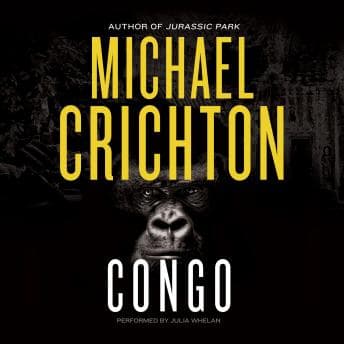

Look, I need to get something off my chest before we go any further. Michael Crichton's obsession with technical jargon nearly lost me in the first two hours. I'm driving through Hill Country on my way to a client meeting, and suddenly I'm getting a master class in satellite uplink frequencies and primate linguistics. Ranger's in the back seat, probably wondering why I'm muttering "get to the gorillas already" at my dashboard.
But here's the thing—once this book gets moving, it really moves. Combat-deployment-level intensity.
When Crichton Finally Lets It Rip
The setup takes its sweet time. You've got Karen Ross with her corporate tech-thriller energy, Peter Elliot and his signing gorilla Amy, and enough scientific exposition to fill a Pentagon briefing. I was skeptical. I've read enough Crichton to know he loves his research, but sometimes the man forgets he's writing a novel and not a doctoral thesis.
Then they hit the Congo. Everything changes.
The pacing shifts from academic lecture to full-throttle survival horror. Hostile territory, unknown threats, a team way out of their depth. I've seen similar scenarios play out in real life—not with killer apes, obviously—but that feeling of being in unfamiliar terrain with inadequate intel? Crichton nails it. That knack for dropping ordinary people into a bad situation with nowhere easy to run is why I keep circling back to Eaters of the Dead. The tension ratchets up in a way that had me missing my exit twice. (My client was not thrilled, but worth it.)
The Lost City of Zinj and those gray gorillas—I won't spoil it, but the author clearly did his homework on primate behavior, then twisted it into something genuinely unsettling. The kind of threat that feels plausible enough to stick with you. Way more effective than the movie, which I remember being... not great.
Julia Whelan Behind the Wheel
Julia Whelan narrating a Crichton techno-thriller wasn't the obvious choice I would've made. She's known for literary fiction, romance, that kind of thing. But she absolutely delivers here. Her range shows up in a completely different register in Maybe in Another Life, which makes this hard-charging performance all the more impressive.
Her pacing matches Crichton's breathless action sequences perfectly. When things go sideways in the jungle—and they go sideways fast—Whelan keeps the momentum without sacrificing clarity. That's harder than it sounds. I've listened to plenty of action audiobooks where the narrator either rushes through the good stuff or plods along like they're reading a bedtime story.
Her character voices are solid. Amy the gorilla's "speech" (conveyed through sign language in the text) comes across with real personality. Karen Ross sounds appropriately driven and corporate-cold. The male characters are distinguishable without Whelan doing anything cartoonish. Professional work all around.
My only minor gripe—and it's minor—is that some of the technical passages feel a bit flat. But honestly, that might be the material itself. There's only so much excitement you can inject into satellite communication protocols.
Who's This Mission For?
If you like your adventure with a side of hard science and don't mind earning your payoff, this is a solid listen. Skip it if you need immediate action or can't stomach animal harm—there's some here that might bother sensitive listeners. But for Crichton fans and anyone who wants smart, propulsive thriller writing that's just plausible enough to be creepy? Green light.
Mission Debrief
Here's what you need to know: the first third is a slow burn. Lots of setup, lots of science, lots of corporate maneuvering. If you're impatient, you might bail early. Don't.
Once the expedition hits the ground in Africa, this becomes a legitimate page-turner. Or... ear-turner? Whatever. The point is, I burned through the back half in two days of driving and one late night in a hotel room. Ranger approved—he didn't even bark at the tense parts, which is his version of a standing ovation.
Vintage Crichton—smart, propulsive, and genuinely superior to that 1995 film adaptation, which somehow made killer gorillas boring.
Mission accomplished. Now if you'll excuse me, I need to explain to Linda why I ordered three more Crichton audiobooks.