
When was the last time you sat with someone else's faith - not to argue it, not to adopt it, but just to listen?
I ask because that's basically what this collection demands of you, and it's a harder exercise than you'd think. I was half-grading a stack of junior essays on The Great Gatsby (yes, they all think the green light means money, every single year) when I put this on at about 10:45 PM. Fifty-five minutes. A handful of short readings from different faith traditions, all public domain, all performed by LibriVox volunteers. And something about the smallness of it - the brevity, the modesty - caught me off guard.
What Fits Inside Fifteen Minutes
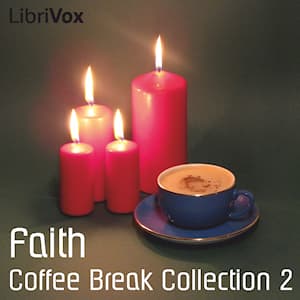
Let's talk about what this actually is, because the packaging undersells it. "Coffee Break Collection" sounds like something you'd grab at an airport newsstand. But the premise is genuinely interesting: curate short works - poems, essays, excerpts - around the theme of multi-faith expression, none longer than fifteen minutes. It's an anthology of spiritual fragments. You get Christian devotional writing rubbing shoulders with texts from other traditions, and the cumulative effect is less like a theology seminar and more like eavesdropping on different people praying in adjacent rooms. The Christian New Testament is one of those source texts lurking behind several pieces here - and if you want to hear the original cadences these writers were drawing from, that LibriVox recording gives you exactly the same rough-edged, earnest quality.
The pieces themselves are public domain, which means we're talking older language, formal cadences, the kind of prose my students would call "extra" before tuning out entirely. But here's the thing - and this is why we still read the classics - that formality carries weight when the subject is faith. These writers weren't trying to be accessible or viral. They were trying to articulate something they believed was ultimate. The density is the point.
At under an hour total, you're not committing to anything. You're sampling. And I think that's actually the right way to encounter unfamiliar spiritual writing - in small, digestible pieces where you can sit with a phrase before the next voice arrives.
The Volunteer Problem (And Why It's Also the Charm)
Okay, I have to be honest here, because the narrator situation is - complicated. LibriVox volunteers are unpaid readers donating their time, and the quality varies in exactly the way you'd expect. Some voices are warm, measured, clearly comfortable behind a microphone. Others sound like they're reading in a room with an echo, or rushing slightly, or hitting emphasis in places that made me cock my head.
I can't give you the usual narrator breakdown because there's no single performance to evaluate. It's a rotating cast of amateurs, and that inconsistency is both the weakness and - I'm going to argue this - part of the experience. These aren't actors interpreting text. They're people reading words about faith that apparently mattered enough to them to sit down and record. There's something raw about that. Not polished. Not produced. Just... earnest.
The narrator understands that pause is punctuation - well, some of them do. Others barrel through. You take what you get.
Production-wise, you'll notice differences in recording quality between pieces. Some are clean and close-mic'd, others have that slight hollow quality of someone's home office at 2 AM. If pristine audio matters to you, this will grate. If you can roll with it, the roughness starts to feel appropriate for the subject matter. Faith isn't polished either.
Who Should Pour This Particular Cup
This is for the curious, not the devout. If you want deep theological argument, you won't find it here - the pieces are too short for that. But if you're someone who likes to encounter unfamiliar perspectives in low-stakes doses, this is a surprisingly good use of fifty-five minutes. It's also genuinely useful if you teach comparative religion or literature with spiritual themes - I'm already thinking about borrowing a piece or two for my unit on transcendentalist writers.
My students would hate this. I love it. (Though I'll admit even I wouldn't assign the whole thing.)
If you need narrative, character, plot - skip this entirely. If you want entertainment, this isn't it. But if you've got a short commute and you're tired of podcasts telling you what to think, there's something quietly refreshing about old words from strangers who believed deeply and wrote about it plainly.
It's free, it's short, and it asks almost nothing of you except attention. The prose deserves to be savored, even when the reader delivering it isn't quite up to the task.
The Grade I'd Give My Own Students
Worth your time? At fifty-five minutes and zero dollars, the bar is low and the collection clears it. It's not going to change your life, and the volunteer narration means you're trading production value for authenticity. But I finished it, went back to those Gatsby essays, and found myself thinking differently about the paragraph where Nick talks about belief. That's not nothing.