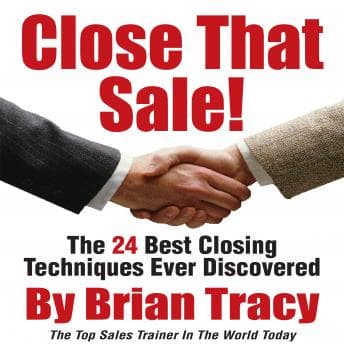

What exactly happens in the brain when someone says "yes" to a purchase? And more importantly—can you engineer that moment?
I was chopping onions for a dal that was definitely going to be too spicy (my mother's voice in my head: "Priya, why must you always overdo the green chilis?") when I decided to listen to something completely outside my usual lane. Brian Tracy's Close That Sale! sat in my library for months, a gift from a cousin who sells pharmaceutical equipment. "You study why people do things," he said. "This is why people buy things." Fair enough.
The Psychology Hiding in Plain Sight
Here's what struck me: Tracy presents 24 closing techniques, but what he's really doing—whether he realizes it or not—is cataloging human decision-making patterns. The "Summary Close" where you recap all benefits before asking for commitment? That's working memory consolidation. The "Puppy Dog Close" where you let someone try before buying? Classic loss aversion in action. Research shows that once we possess something, even temporarily, we value it 2-3 times more than before we held it.
Tracy doesn't use academic language. He doesn't cite Kahneman or Cialdini. The same gap between practical application and theory shows up in Real Book of Real Estate, where practitioners share what works without necessarily explaining the underlying psychology. But the behavioral frameworks are all there, dressed in business casual. I found myself asking: why does this feel manipulative when written in a sales book but "insightful" when published in a psychology journal? The protagonist exhibits classic cognitive dissonance—and by protagonist, I mean me.
The book moves fast. Twenty-four techniques in 75 minutes means you're getting maybe three minutes per concept. Tracy clearly knows his material—he's been teaching this stuff for decades—and his delivery has that confident, almost paternal authority. "Do this. It works. Here's why." No hedging, no excessive qualifications.
When the Guru Becomes the Case Study
Brian Tracy narrating his own work creates an interesting dynamic. You're essentially getting a sales pitch about sales pitches, delivered by someone who has clearly internalized every technique he's teaching. His pacing is brisk—some listeners find it too fast to absorb, and honestly? They're not wrong. This is a book designed for multiple listens, not one-and-done comprehension.
What makes this approach compelling is the meta-awareness it requires. Tracy uses the very techniques he's describing as he describes them. The assumptive language. The confident assertions. The strategic pauses before key points. It's a demonstration of showing rather than telling—though I suspect that's not entirely intentional.
Psychologically, this doesn't track as pure manipulation. Tracy genuinely believes he's helping people. And maybe he is? Sales, stripped of its sleazy cultural baggage, is just persuasion. And persuasion is just... understanding what people want and showing them how to get it. My therapist would have thoughts about this character—specifically, about his absolute certainty that helping people buy things is equivalent to helping people.
Who Gets Value Here (And Who Won't)
If you're in sales—actual sales, with quotas and commissions and that particular stress—this is a dense little toolkit. The brevity works in your favor because you can revisit specific techniques before client meetings. I imagine listening to the "Invitational Close" chapter in the parking lot before a big pitch.
If you're like me, curious about the mechanics of influence but not actively selling anything, this is a fascinating case study in applied psychology. Not deep, but practical. The kind of book that makes you notice techniques being used on you, which is its own form of education.
Skip this if you want nuanced ethical discussion about the psychology of persuasion. Tracy operates in a world where closing the sale is unambiguously good. No examination of when you shouldn't close. No acknowledgment that some of these techniques work precisely because they bypass rational decision-making. Manifesting Change operates in a similar ethical vacuum, presenting techniques as universally beneficial without examining when they might not serve the user's actual interests.
Notes From a Burned Dal
I burned the dal. Got too caught up in analyzing Tracy's use of social proof examples and forgot to stir. But I also understood something I hadn't before: sales techniques aren't magic. They're just formalized versions of what effective communicators do naturally. The "feel, felt, found" method for handling objections? That's active listening with structure. The "Ben Franklin Close" where you list pros and cons? That's externalized decision-making.
This is a fascinating case study in how practical knowledge and academic theory often describe the same phenomena in different languages. Tracy has spent forty years observing what works. Psychology has spent a century trying to explain why.
At 75 minutes, this is barely a commitment. Listen at 0.9x speed if you want to actually absorb the techniques. Listen at normal speed if you're just trying to understand the framework. Either way, you'll come out with a slightly more cynical—or maybe just more aware—understanding of every transaction you've ever made.
C'est la vie commerciale.