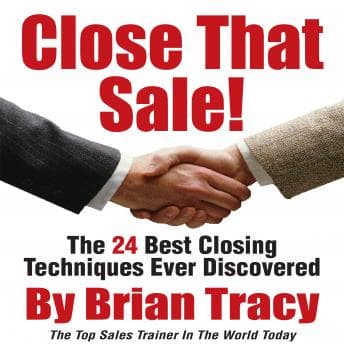

Three hours and seventeen minutes. That's the runtime. I want you to sit with that number for a second because in the business audiobook world, that's basically a pamphlet. And honestly? That restraint might be the best thing Brian Tracy ever did with this book.
I was meal-prepping Sunday night - Jenny has me on some rotation involving quinoa and roasted vegetables I don't fully understand - when I threw this on. Figured I could knock it out before the chicken thighs finished. I was right. And the fact that I could finish an entire business book during a single cooking session tells you everything about why I have complicated feelings here.
The 80/20 Rule Applied to Its Own Content
Tracy opens with the Pareto principle - 80% of sales made by 20% of salespeople - and then proceeds to give you 21 techniques that are essentially Sales 101 compressed into digestible chunks. Set goals. Know your product. Qualify prospects early. Build rapport. Handle objections. Follow up.
If you've been in sales for more than six months, you've heard every single one of these. And that's the weird tension with this book. Nothing here is wrong. It's all correct. It's the sales equivalent of a doctor telling you to eat well and exercise. Like - yes, obviously. But are you doing it? Probably not consistently. And that's where Tracy's value proposition lives.
My parents didn't know the phrase "competitive advantage analysis" when they were running the dry cleaners, but they sure as hell knew every other cleaner's prices within a two-mile radius and exactly what services those shops couldn't match. This is what my parents did instinctively. Now it has a TED talk. Tracy's section on identifying your competitive edge and articulating it in the first 30 seconds of a prospect interaction - that's probably the densest bit of actual utility in the whole listen. He breaks persuasion into three keys (which I won't spoil, but one of them is so obvious you'll kick yourself for not systematizing it sooner).
The "megacredibility" concept is another highlight - basically engineering your entire presentation around proof points before you ever ask for the sale. I've seen variations of this work at two different SaaS startups I consulted for. The ones who built credibility stacks into their sales decks closed 40% faster than the ones who led with features. Tracy doesn't go that deep into implementation, but the framework is sound.
The Mouth Noise Problem Nobody Warned Me About
Okay, I need to address the elephant in the room. Tracy narrates his own book, which normally I prefer - author-narrated business books carry a certain authority that hired guns can't replicate. And his delivery is clear, confident, direct. The man has done 500+ audio programs. He knows how to pace himself.
But. The mouth sounds. Once you hear them, you cannot unhear them. There's this lip-smacking thing happening between sentences that at 2.0x speed becomes this rhythmic wet clicking that had me checking if I'd accidentally spilled something on my AirPods. It's not constant, but it's frequent enough to be genuinely distracting during the sections where you're trying to absorb his frameworks. Some listeners apparently couldn't make it past 10 minutes. I powered through because I'm stubborn and also the quinoa was only half done, but I get it. A basic audio cleanup pass would've fixed this entirely. The fact that it wasn't addressed feels like someone skipped QA.
Who Gets ROI Here and Who Doesn't
If you're brand new to sales - first year, maybe switching careers, just got handed a territory and a Salesforce login - this is genuinely useful. Tracy lays down fundamentals with zero fluff, and the short runtime means you can actually re-listen to specific sections before a big call. That's real utility.
If you're mid-career with five-plus years of quota-carrying experience? Skip to whatever chapter covers the objection handling framework and the megacredibility piece. The rest is review. Useful review, maybe, like re-reading your notes before an exam, but review nonetheless.
If you're a founder or consultant who doesn't think of themselves as "in sales" but absolutely is? Actually, this might hit different for you. Tracy strips away all the sleazy used-car-lot energy that makes smart people allergic to the word "sales" and frames it as a professional discipline. Which it is.
Senior sales leaders looking for cutting-edge methodology, behavioral economics applications, or anything written after 2010? This isn't your book.
The Credit-or-Skip Calculation
Bottom line: At 3 hours 17 minutes, this is priced like a full audiobook but sized like a long podcast episode. The content is solid-not-spectacular - the kind of fundamentals checklist that works better as a reference you revisit quarterly than a one-time revelation. Tracy's authority is legitimate, his frameworks are field-tested, and the brevity is genuinely respectful of your time. Good to Great sets a different kind of bar for this genre — deeper research, harder-won conclusions, and a production quality that made me trust every word before Tracy had even opened his mouth. But the audio quality issues are real, and nothing here will surprise anyone who's read even two other sales books. Finally, a business book that respects your time - I just wish the production respected your ears equally. Jenny would say I'm being harsh. Jenny is right. But she also doesn't have to listen to audiobooks with mystery mouth sounds while chopping bell peppers.