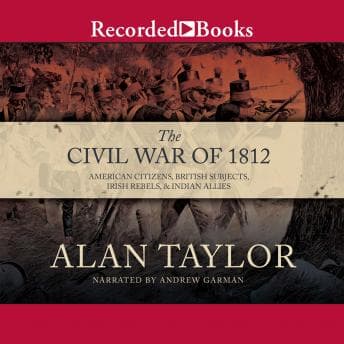

Most Americans think the War of 1812 was just the British burning the White House and Francis Scott Key writing a poem on a boat. Maybe the Battle of New Orleans if they paid attention in high school. But Alan Taylor? He throws that simplistic nonsense out the window.
I listened to this over about two weeks of driving between client sites in Austin. And let me tell you, this isn't the "good guys vs. bad guys" history we usually get fed. It's messy. It's brutal. And honestly, it felt familiar.
When Neighbors Kill Neighbors
Taylor calls this a "Civil War," and he's spot on. The border between the U.S. and Canada wasn't a line in the sand; it was a porous mess where families were split down the middle. You had Irish rebels fighting for the U.S. because they hated the Crown, and former Americans fighting for the British because they wanted land or stability.
It reminded me of working in sectors in Iraq where loyalties shifted depending on who was winning that week. Taylor doesn't shy away from the incompetence, either. The sheer number of tactical blunders on both sides—it's almost funny if it wasn't so tragic. Generals who didn't know the terrain, militias that refused to cross state lines... I've seen logistics failures, but the War of 1812 was a case study in how not to run a campaign.
(Linda asked me why I was shouting at the windshield on I-35. I was frustrated with a New York militia commander from 1812. She just rolled her eyes.)
The Speed Dial is Your Friend
Let's talk about Andrew Garman. He's got a voice like a history professor who really cares about the subject—gentle, precise, very clear. He handles the pronunciation of the French and Indigenous names with a level of care that I respect. A lot of narrators butcher that stuff.
But—and this is a big but—the man takes his time.
I usually listen at 1.25x. For this one? I had to bump it to 1.5x, and honestly, I flirted with 2x. At 1.0x speed, it felt like a briefing that could've been an email. The pacing is just too slow for a book this dense. If you don't speed it up, you might drift off during the detailed political maneuvering in Upper Canada. Garman is good, don't get me wrong, but he needs a little caffeine.
Who's This Intel For?
If you want heroic charges and glory, look elsewhere. This is for the history nerds who want to understand why the U.S.-Canada border exists where it does, and what it cost the Native nations caught in the middle. Skip it if you need action-packed pacing or can't handle 20 hours of granular political and military detail.
Mission Debrief
This isn't a light beach read. It's 20 hours of granular detail about a war that redefined the continent. Taylor digs into the "Indian Allies" aspect heavily, showing how the Native nations were trying to play both empires against each other to survive. It's grim stuff.
This is history with the mud left on the boots. It's scholarly, yeah, but it's the kind of intel that actually explains why the U.S. and Canada look the way they do today. Radium Girls gave me that same feeling—history that doesn't sanitize the human cost.
Ranger slept through most of it, but that's just because the tone is soothing. For me? It was worth the time. Just make sure you know where the speed button is.


![Steve Jobs [unabridged audiobook] audiobook cover](/_next/image?url=https%3A%2F%2Fcovers.audiobooks.com%2Fimages%2Fcovers%2Ffull%2F9788499923406.jpg&w=1920&q=75)