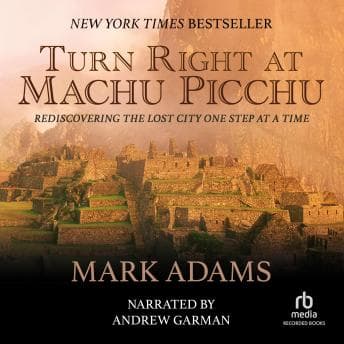

I'll admit it. When everyone kept telling me this was a hilarious adventure book, I was skeptical. Twenty years of teaching has made me deeply suspicious of anything marketed as "funny" - my students think adding "bruh" to Shakespeare makes it comedy. But Mark Adams? The man actually made me laugh out loud during a faculty meeting. Principal Martinez definitely noticed. Worth it.
Here's the thing about this book that nobody seems to mention: it's really two books braided together. You've got Adams - a self-proclaimed "unadventurous adventure writer" who has literally never slept in a tent - stumbling through the Andes with a hard-as-nails Australian guide named John Leivers. And then you've got the historical thread about Hiram Bingham III, the Yale professor who "discovered" Machu Picchu in 1911. (Those quotation marks are doing a lot of heavy lifting, and Adams knows it.)
Two Timelines, One Mountain
Some listeners apparently found the back-and-forth structure disjointing. I get it. But honestly? This is exactly how I teach historical context to my juniors. You can't understand what Bingham found without understanding what Adams is looking for. And you can't appreciate the absurdity of a desk-bound writer hiring a survivalist to drag him through one of the world's most unforgiving landscapes without knowing what drove Bingham to do it first - with way less Gore-Tex.
The historical sections reminded me of what Hemingway said about the iceberg theory. Adams gives you just enough Incan history to understand the stakes without turning it into a textbook. He's wrestling with a genuinely complicated question: Was Bingham a hero, a villain, or just a complicated guy who happened to stumble onto something extraordinary? Adams doesn't give you easy answers, and I respect that.
Andrew Garman Gets the Rhythm Right
I listen at 1.0x because the author chose those words. Andrew Garman seems to understand this instinctively. His pacing matches the material - measured during the historical sections, livelier when Adams is complaining about altitude sickness or John Leivers is being magnificently, terrifyingly competent.
And that Australian accent for Leivers? Genuinely fun. It's the kind of voice work that would be lost entirely if you read the print version. Garman doesn't overdo it - he's not doing a caricature - but he captures something essential about this guy who casually mentions he's been "in some scrapes" while leading Adams up vertical cliff faces. He understands that pause is punctuation, and he uses silence beautifully after Adams' driest observations.
I couldn't find much about Garman's other work online, but based on this performance, he's got real range. The pronunciations of Quechua place names sound confident and consistent, which matters more than you'd think over ten hours.
The Slow Burn That Paid Off
I listened to most of this walking the lakefront with Denise, which felt appropriate. Adams is essentially on a very long, very uncomfortable walk himself. There are stretches where not much happens plot-wise - they hike, they camp, Adams suffers - but the observations keep you hooked. He's genuinely curious about everything: the history, the landscape, the people, the llamas. (There's a lot about llamas. I now know more about llama behavior than I ever expected to.)
My students would hate this. I love it.
The pacing does drag in a few spots during the middle third. I'll be honest - there were moments where I zoned out during particularly detailed descriptions of archaeological theory. But Adams always pulls you back with something sharp or self-deprecating. The man has no illusions about himself, and that humility makes the whole thing work.
Who's Going to Love This (And Who Won't)
If you loved Bill Bryson's travel writing, this is its spiritual successor - maybe a little more historically rigorous, a little less purely comic, but cut from the same cloth. That same blend of humor and historical weight shows up in Friday Night Lights, though Bissinger trades Andean peaks for Texas football fields. Adams isn't trying to be Bryson, though. He's doing his own thing: part travelogue, part historical investigation, part midlife meditation on what it means to actually experience something instead of just writing about it.
Skip this if you need constant action or want a straightforward adventure story. But if you're the type who enjoys watching a self-aware writer slowly realize he's in over his head while learning something genuine about history? You'll be hooked.
The question at the heart of this book - what was Machu Picchu actually for? - never quite gets a definitive answer. But that's the point. Adams is honest about the limits of what we can know, and he's more interested in the journey than the destination. (Yes, I know that's a cliché. Sometimes clichés are true.)
Class Dismissed
Perfect for long drives, morning walks, or pretending to pay attention to budget presentations. Just don't blame me when you laugh out loud at the wrong moment.