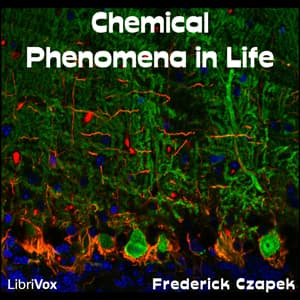

What did scientists in 1911 think was happening inside a cell?
I found myself wondering this at 6:47 AM somewhere between Millbrae and San Mateo, half-awake and staring at the fog rolling past the window. My usual sci-fi queue felt too demanding, so I'd grabbed this short LibriVox recording on a whim. Three hours and forty-one minutes of century-old biochemistry. Why not?
Turns out, there's something genuinely fascinating about hearing scientists theorize before they had the tools to prove themselves right. Or wrong.
The Intellectual Time Capsule Effect
Frederick Czapek was a Czech botanist writing about plant cell chemistry when we didn't even know what DNA was. The double helix was still 42 years away. Electron microscopes? Decades out. And yet here's this guy meticulously cataloging what he could observe about cellular processes, making educated guesses that—honestly?—are sometimes eerily close to what we'd later confirm.
The ROI on this audiobook isn't what you'd expect. It's not practical knowledge. You're not going to apply 1911 biochemistry to anything. But as a software engineer who spends her days debugging systems, I found myself appreciating Czapek's methodology. He's essentially doing what we do: working with incomplete information, building mental models, testing hypotheses. Except his "logs" are microscope observations and his "stack traces" are chemical reactions he can barely measure.
This is basically a snapshot of the scientific method before we had the compute power to back it up.
J.M. Smallheer Does the Heavy Lifting
Let's be real—this could have been unbearable. Dense scientific text from 1911, full of terminology that's either archaic or unchanged (chemistry is weird like that). But Smallheer reads it clean. No dramatic flair, no attempts to make it "exciting." Just clear, steady delivery that respects both the material and the listener's intelligence.
Is it going to win any narrator awards? No. But for a LibriVox volunteer tackling obscure scientific literature, the competence level is genuinely impressive. I never had to rewind because of unclear pronunciation or weird pacing. That matters when you're half-conscious on public transit.
The single-narrator format works fine here—there's no dialogue to differentiate, no characters to voice. It's academic prose, and Smallheer treats it as such.
The Czapek-Dox Connection (For Fellow Nerds)
Here's a detail that made me sit up straighter: Czapek invented Czapek solution agar. If you've ever worked in a lab that cultures fungi—or if you've read anything about growing Aspergillus or Penicillium—you've encountered his work. The guy who wrote this audiobook literally created a standard culture medium still used today. That kind of lasting practical impact—where someone's work outlives their era—reminded me of the enduring questions Hawking tackles in Brief Answers to the Big Questions.
That context transformed my listening experience. This isn't just some random Victorian-era scientist rambling about cells. This is someone whose practical contributions outlasted his theoretical ones by over a century. His culture medium is probably in use right now, somewhere, growing mold for research or antibiotics production.
(Kevin would point out that I'm nerding out about fungus growth medium at 7 AM. He'd be correct.)
Who Should Actually Listen to This
Perfect for: History of science enthusiasts, biology majors who want context for modern biochemistry, anyone curious about how we knew things before we could prove them, insomniacs who find academic prose soothing.
Skip if: You need practical takeaways, narrative drive, or you find dated scientific terminology more frustrating than charming.
At 3 hours 41 minutes, it's exactly two commutes. The brevity is a feature—you get the intellectual novelty without overstaying the welcome.
The Debugging Analogy That Won't Leave My Head
I kept thinking about this: Czapek was essentially reading logs from a system he couldn't fully instrument. He could see inputs and outputs, observe some intermediate states, but the actual processes were black boxes. Sound familiar?
That's what made this unexpectedly engaging. Not the specific chemistry—a lot of which has been refined or corrected since 1911—but the problem-solving approach. The careful observation, the logical inference, the acknowledgment of uncertainty. It's how good engineers think, just applied to plant cells instead of distributed systems.
Would I recommend spending an Audible credit on this? Absolutely not. It's free on LibriVox and Archive.org. But for a free listen that makes you appreciate how far science has come—and how the fundamentals of good methodology haven't changed—it's a surprisingly solid use of commute time.




![Steve Jobs [unabridged audiobook] audiobook cover](/_next/image?url=https%3A%2F%2Fcovers.audiobooks.com%2Fimages%2Fcovers%2Ffull%2F9788499923406.jpg&w=1920&q=75)