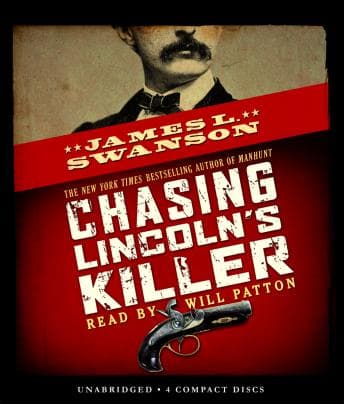

Four hours. That's all it takes. Four hours to cover twelve days that changed American history, and honestly, I wasn't ready for how much Swanson packs into that runtime.
I started this one during a Sunday morning walk along the lakefront with Denise - she had her own earbuds in, some true crime podcast, and I figured my choice was basically the same genre, just 160 years older. The April wind off Lake Michigan felt appropriate. There's something about listening to a manhunt unfold while you're physically moving through space that makes the geography real - the swamps of southern Maryland, the Potomac crossing, the Virginia pine forests closing in around Booth.
History That Reads Like a Warrant
Here's what Swanson does that most history writers don't bother with: he makes you feel the clock. This isn't a textbook account of the Lincoln assassination. It's structured like a chase thriller, cutting between the manhunters closing in and Booth dragging his broken leg through increasingly desperate hideouts. The narrative swings between national mourning - the black crepe draped over Washington, the funeral train - and Booth's delusional journal entries where he genuinely couldn't understand why the country wasn't thanking him. That disconnect is chilling. My students would probably call Booth "unhinged" and leave it there, but Swanson gives you enough of his psychology to understand how a man could murder a president and feel righteous about it.
Now, I should be transparent about something. This is a young adult adaptation of Swanson's adult book Manhunt, and you can feel the trimming. Some of the conspiracy threads get simplified. The trial gets compressed. If you're a deep Lincoln assassination nerd, you might want the fuller version. But as a piece of storytelling aimed at getting younger readers hooked on history? This reminds me of what Hemingway said about prose being architecture - Swanson has stripped this down to load-bearing walls, and every single one of them holds.
Will Patton Knows When to Whisper
Will Patton. The narrator understands that pause is punctuation. His reading of the final sequence at Garrett's tobacco barn in Virginia - where federal troops corner Booth and the barn catches fire - had me standing still on the lakefront path like an idiot while joggers went around me. Patton drops his voice to something barely above a whisper during the moments of national grief, then ratchets up to this urgent, clipped delivery during the chase sequences. It's not showy. He's not doing full theatrical voices for every character, but there's enough vocal distinction that you always know who's speaking. His Booth has this brittle arrogance to it - you can hear the actor's vanity in the voice, which is exactly right, because Booth WAS an actor, and that performative self-regard was central to everything he did.
The one thing I'll push back on is the crowd who says to speed this up to 1.25x. I listened at 1.0x because the author chose those words and Patton chose those pauses, and I think the slower pace actually serves the material. The twelve-day manhunt felt long to the people living through it. Let it feel a little long to you too. That's the point.
The Classroom Test
I've been teaching for twenty years and I know exactly which of my students would devour this and which would zone out. The ones who think history is just names and dates? They need this audiobook. Swanson writes history the way it actually happens - messy, contingent, full of near-misses and dumb luck. That same messy, contingent storytelling is what hooked me on Ross Poldark - history that keeps reminding you nobody at the time knew how it was going to end. Booth almost got caught multiple times. The conspiracy involved bumbling co-conspirators who nearly blew the whole plan before it started. Real history is stranger and more chaotic than the textbook version, and Swanson gets that.
But here's who might be disappointed: anyone expecting deep analysis of Reconstruction, the political aftermath, or what Lincoln's death meant for the trajectory of American race relations. Swanson stays in thriller mode. The chase IS the book. That's both its greatest strength and its limitation.
Worth Pausing the Faculty Meeting For
At under four hours, this is the kind of audiobook you can finish in a weekend of errands and dog walks. Will Patton's performance elevates good historical writing into something that genuinely moves. Is it the definitive Lincoln assassination book? No - go read Manhunt for that, or better yet, listen to it. But as an entry point, as a way to make a 160-year-old manhunt feel like it's happening in real time? This is why we still read the classics - even the ones about the darkest chapters. Especially those.