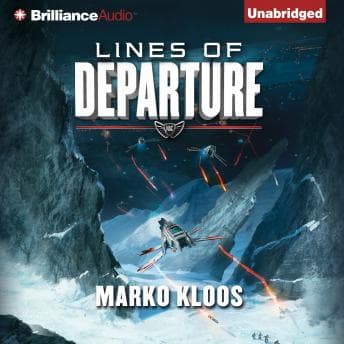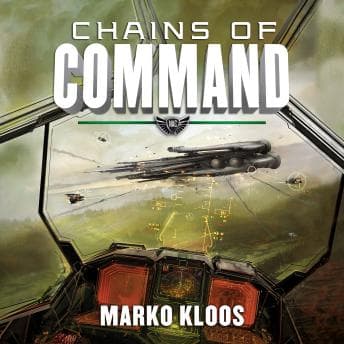

Everyone told me the Frontlines series was "Starship Troopers meets Call of Duty" and I went in expecting something I'd have to grade on a curve - the literary equivalent of a summer action flick. Four books deep now, and I owe Marko Kloos an apology. This isn't popcorn military sci-fi. Or rather, it is, but it's the kind where the kernels have actual weight.
I started Chains of Command during a Friday night grading marathon - stacks of sophomore essays on Lord of the Flies that were slowly draining my will to live - and by midnight I'd forgotten about Piggy entirely. Which, if you know me, is saying something.
Andrew Grayson Is the Veteran Hemingway Would've Written in Space
Let's talk about what Kloos is really saying with Grayson in this book, because it's not subtle but it doesn't need to be. Here's a platoon sergeant self-medicating with booze and pills, crash-coursing green volunteers through training while his own hands are still shaking from the last deployment. The survivor guilt isn't some background flavor text - it's the structural backbone of the first third. Kloos writes it with the flat, unsentimental honesty of someone who's done his homework on PTSD. There's a death scene involving a pilot that hit me harder than I expected at 1 AM on a school night. Not because of melodrama - because of its absence. The narration just... sits in the silence after it happens. The narrator understands that pause is punctuation.
This reminds me of what Hemingway said about writing - the dignity of movement of an iceberg is due to only one-eighth of it being above water. Kloos keeps most of the emotional devastation below the surface. Grayson doesn't monologue about his trauma. He pours another drink. He snaps at recruits. He functions. Barely. That kind of quiet, accumulating damage in a character reminds me of what Barbara Kingsolver does with Damon Fields in Demon Copperhead — a guy who keeps moving, keeps performing functionality, while the reader watches the floor slowly give out beneath him.
The War Has Two Fronts and Neither Is Simple
Here's where Kloos does something genuinely interesting with the plot architecture. You've got two threats - the Lankies still squatting on Mars, and a fleet of human deserters who stole warships and set up shop on some distant moon. The book could've easily been "aliens bad, go fight aliens." Instead, Kloos forces the North American Commonwealth into an ugly political calculus: do we spend our limited resources hitting the existential alien threat, or do we go after our own people who took hardware we desperately need?
Grayson and Halley - his wife, a dropship pilot, and honestly one of the more believable military marriages I've encountered in fiction - end up on the recon mission to scout the deserters' stronghold. And the tension isn't just tactical. It's moral. These aren't cartoon villains. They're people who looked at the Lanky threat and decided the math didn't work out for Earth. You can disagree with them and still understand the logic. My students would hate this - they want clear heroes and villains. I love it.
The pacing runs lean for the first half (training sequences, political maneuvering, relationship stuff between Grayson and Halley that actually earns its pages) and then accelerates hard into the recon operation. At just under twelve hours, it's a comfortable single-weekend listen if you're committed, or a solid week of commute chapters.
Luke Daniels Earns His Rank
Luke Daniels has been voicing Grayson since book one, and by now he wears this character like a broken-in pair of combat boots. His military cadence is spot-on - the clipped briefing-room delivery, the way officers and enlisted sound fundamentally different not just in accent but in rhythm. There's a weariness in his Grayson that wasn't there in the earlier books, and it's the right call. This is a man running on fumes and duty.
One small thing: he stumbles on the name "MC Fallon" a couple of times - pronounces it inconsistently in a way that briefly pulled me out. Minor. Like a typo in an otherwise clean manuscript. The emotional scenes land hard precisely because Daniels doesn't oversell them. When that pilot dies, his voice doesn't crack theatrically. It just... goes flat. Which is exactly what shock sounds like.
The prose deserves to be savored at 1.0x. Daniels' pacing matches Kloos' sentence structure - short declarative bursts during action, longer breathing room during the quieter character moments.
Who This Is For (and Who Should Bail)
If you loved The Forever War by Joe Haldeman, this is its spiritual successor - not in plot, but in that same weary-soldier honesty about what combat costs. If you're already in the Frontlines series, this is the book where the stakes shift from survival to strategy, and it's worth the ride. If you need your sci-fi to come with literary pretensions and zero gunfire, this isn't your thing. But if you want military fiction that respects both the genre and its characters' inner lives? Worth pausing the faculty meeting for.
(Principal Martinez, I promise I only listened to two chapters during the curriculum review. Three, tops.)
The Assignment
Book four in a series is a weird place to prove you're doing something beyond genre exercise, but Kloos pulls it off. The war is bigger, the politics are muddier, and Grayson is more broken than ever - which makes him more human than ever. Daniels' narration is the right voice for this story, full stop. Not perfect, but damn close. This is why we still read the classics of any genre - because the good ones keep finding new things to say about old human problems. Even in space.