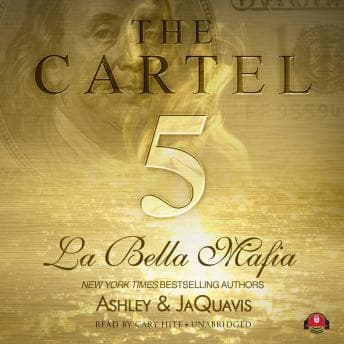

I was grading papers at 11 PM - the usual stack of half-hearted essays on The Great Gatsby where every student thinks they're the first to notice the green light is symbolic - when I decided I needed something that would keep me awake without requiring me to parse another teenager's interpretation of the American Dream. The Cartel 5 was not what I expected to reach for. But here's the thing about twenty years of teaching canonical literature: sometimes you need the exact opposite of what you assign.
And La Bella Mafia? It delivered something I genuinely wasn't prepared for.
When the Men Fall, the Women Rise
Ashley & JaQuavis open with a Boeing 747 dropping from the sky, taking the male power structure of the Carter family with it. Brutal, efficient storytelling. No prolonged setup, no hand-holding. The federal government is circling, the empire is crumbling, and the women - who've been positioned as accessories for four books - suddenly have to become the architects.
This reminds me of what Hemingway said about writing: "The dignity of movement of an iceberg is due to only one-eighth of it being above water." Ashley & JaQuavis work differently. Everything is above water. The violence, the grief, the ambition, the betrayal - it's all surface-level, all immediate, and somehow that directness becomes its own kind of power. There's no subtext to decode. The prose doesn't ask you to savor it; it demands you keep up.
The move from Miami to new territory - the family trying to go legit while tangling with an Arabic millionaire who doesn't know or care about the Carter name - creates genuine tension. My students would hate this. I loved it. The women aren't written as softer versions of their men. They're calculating, ruthless, and occasionally terrifying in ways that feel earned rather than performed. Second Wife explores similar territory with women navigating power structures built by men, though in a very different setting.
Cary Hite: The Polarizing Choice
Here's where I need to be honest. Cary Hite's narration is going to split listeners right down the middle, and I understand both camps.
Hite commits fully to the urban fiction voice - the slang, the accents, the rhythms of street dialogue. For some listeners, this is immersive. You feel like you're in the room. The emotional delivery during the heavy scenes - and there are heavy scenes, the kind that made me stop grading entirely and just listen - lands with real weight. I found myself genuinely moved in moments I didn't expect.
But. (And this is a significant but.) If you're not already familiar with the Cartel series, if the vernacular isn't something you're accustomed to, Hite's choices might feel like a barrier rather than a bridge. Some accents veer into territory that could read as caricature to the wrong ear. I caught myself wincing once or twice, not because the performance was bad, but because it was so committed that it left no room for neutrality.
The prose deserves to be savored - or at least, it deserves whatever your version of savoring looks like. I listen at 1.0x because the author chose those words, and Ashley & JaQuavis chose these rhythms for a reason. Speeding up would lose something essential.
The Streets Won't Let Them Go (And Neither Will You)
The central tension - a crime family trying to go corporate while the streets keep pulling them back - isn't new. It's the Godfather arc, the Breaking Bad trajectory, the fundamental question of whether you can ever really leave. Pineapple Street wrestles with a gentler version of this - old money families trying to maintain legitimacy while their foundations crack. But the execution here feels fresh because the women aren't just inheriting the men's problems. They're building something different, even as they're forced to use the same brutal tools.
I laughed at moments I probably shouldn't have. I felt something uncomfortably close to grief during others. At 8 hours and 47 minutes, it's a commitment, but not an unreasonable one. The pacing is relentless - this is not a slow burn. Things happen, consequences land, and the story keeps moving.
Content warning for the faculty meeting crowd: violence, language, and sexual content are all present and not subtle. Principal Martinez, if you're somehow reading this review, this is definitely not on the approved curriculum list.
Class Dismissed
Look. This is not Middlemarch. It's not trying to be. Ashley & JaQuavis are New York Times bestselling authors for a reason - they understand pacing, they understand stakes, and they understand how to make you care about characters operating in moral territory that should make them unsympathetic.
Who should listen: If you loved the earlier Cartel books, this is essential. If you want propulsive storytelling with genuine emotional stakes and a narrator who commits fully (for better and occasionally worse), La Bella Mafia delivers. Who should skip: If you're new to the series, you could start here, but you'd be missing context that makes the women's rise more meaningful. And if you're looking for literary fiction with layers of subtext to unpack - that's not this.
My 47 podcast listeners would probably be confused by this recommendation. But sometimes the best thing you can do after a day of teaching classics is remind yourself that storytelling takes many forms, and all of them have value.
The essays on Gatsby can wait until morning.