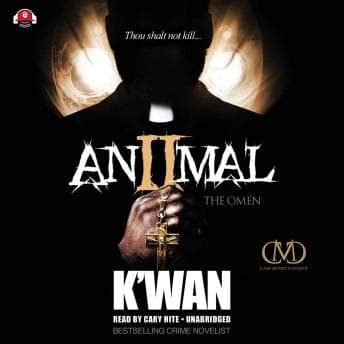

"The man ordered to take Animal from the world is also the man who brought him into it."
I hit that line somewhere around hour five, grading forgotten, red pen rolling off the desk. Denise had gone to bed hours ago. The lakefront walk we'd planned? Abandoned. K'wan had me pinned to my chair with a revelation straight out of Greek tragedy.
I'll be honest. *Animal 2: The Omen* isn't the kind of book I'd typically reach for. My wheelhouse is Fitzgerald, Faulkner, the dusty corners of the Western canon. But a colleague mentioned urban fiction as "the street-level Greek tragedy of our time," and I figured I'd give it a shot. Finished the whole thing during a week of late-night grading sessions. The sophomore essays on *The Great Gatsby* got less attention than they deserved. Worth it.
Blood Debts and Biblical Proportions
Here's what caught me off guard: K'wan is working with classical structures. The father-son revelation between Animal and Priest? That's Oedipus. That's Luke Skywalker. It's the same duality that makes Strange Case of Jekyll and Hyde work—the monster and the man locked in the same body, destroying each other. The man sent to kill you turns out to be the man who created you. Mythic storytelling dressed in Timberlands and street code.
The execution isn't always elegant. The middle drags in places, circling the same vengeance beats until you're checking how much runtime remains. I felt it around hour six—that sense of going through motions, waiting for the next gear shift.
But that ending. The thing with Gucci—I won't spoil it, but I set down my red pen and just sat there. K'wan understands that tragedy requires you to care first, and he earns that investment. Even when the plotting gets predictable, the emotional stakes stay real.
Cary Hite and the Art of Not Overselling
The audiobook includes sound effects—gunshots, ambient street noise, the kind of production flourishes that usually make me roll my eyes. Here? They work. Hite has the exact right tone for K'wan's voice. He doesn't oversell the violence or melodrama; he lets the words do the heavy lifting.
No dramatic vocal gymnastics between characters—no theatrical accent shifts or cartoonish differentiations. What Hite does is maintain consistency. The emotional delivery pulls you through the slower sections, keeps you locked in during the 2 AM stretches when you should definitely be sleeping. That's performance art, even if it's not the kind I usually analyze.
The pacing feels deliberate. Hite knows when to let a moment breathe, when to push through action sequences without rushing. For nearly ten hours of content, that restraint matters.
The Sophomore Slump Question
Sequels carry impossible expectations—the surprise is gone, so the execution has to be tighter. Coming in without reading the first book, I had no comparison point. That probably helped. The father-son dynamic was the revelation for me. Animal's torn loyalty—hating the father who abandoned him while needing him to destroy a common enemy—that's the stuff of real drama.
Prince explores similar territory: family legacy as both weapon and curse, sons trying to escape fathers who keep pulling them back in. Shakespeare wrote this play. K'wan just set it in Harlem.
If you loved the first *Animal* and expect lightning in a bottle twice, you might feel the diminishing returns. The formula shows more clearly the second time around. But if you're here for the tragedy? The operatic family destruction? It delivers.
Who Gets an A, Who Gets Excused
If you want literary prose, pristine sentence construction, the kind of writing you'd assign to AP English students—this isn't it. K'wan writes for velocity and impact, not beauty. The language is functional, sometimes blunt. Skip if you need your fiction polished to a high shine, or if you're not okay with graphic violence, language, and sexual content. K'wan doesn't flinch.
But if you want story? If you want characters making impossible choices under pressure, family bonds twisted into weapons, vengeance that costs more than it pays? This delivers. My students would probably love it. (I'm not assigning it. Principal Martinez reads these reviews. Allegedly.)
Listen if you understand that genre fiction can carry real weight. That tragedy doesn't require togas. That sometimes the best stories come from corners of the world you don't usually visit.
Class Dismissed—But I'm Still Thinking About It
I started this thinking I'd have nothing to say. Ended up with three pages of notes comparing K'wan's narrative structure to classical tragedy. Denise thinks I've lost my mind. She's not wrong.
But here's the thing—great storytelling is great storytelling. K'wan chose these words, chose this structure, chose to make us feel something for a killer named Animal. And Cary Hite chose to honor that with a performance that never winks at the audience, never condescends.
Worth pausing the faculty meeting for. Worth the sleep I didn't get. Worth expanding what I thought I knew about where good stories live.