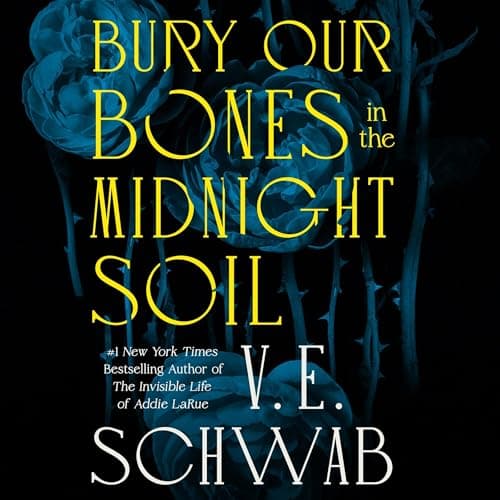

Everyone told me this was Schwab's darkest book yet, and I went in expecting something brutally intense from page one. The reality is more complicated — and honestly, more interesting — than that pitch suggests. Bury Our Bones in the Midnight Soil is less a horror novel and more a slow, gorgeous meditation on what it costs women to survive across centuries, wrapped in a gothic shell that occasionally bares its teeth.
I listened to this during a week of late-night sessions, headphones on after the house went quiet, and that turned out to be exactly the right call. This is not a book you throw on during your commute and half-absorb. The story moves between three women across three timelines — María in 1532 Spain, Charlotte in 1827 London, and Alice in 2019 Boston — and if you lose the thread on any one of them, you'll spend the next twenty minutes confused about whose century you're inhabiting. The structure demands your full attention, and it rewards it, but it does ask a lot. Think of it like a three-way campaign where the DM keeps rotating between party splits — you need to hold all three storylines in your head or the whole thing falls apart.
Let's talk about what makes this audiobook version special, because the three-narrator format is genuinely the right way to experience this story. Julia Whelan handles Sabine's storyline with this low, hungry darkness in her voice that gets under your skin. There's a physicality to her performance — when she narrates bloodlust and decay, you feel the weight of centuries pressing down. Katie Leung brings Alice into sharp focus with a soft Scottish accent that carries real grief in it; her modern-day sections feel the most emotionally accessible, like a friend telling you something terrible that happened to her. And Marisa Calin's crisp English accent for Charlotte's sections perfectly captures that high-society cage Charlotte inhabits before everything unravels.
The handoffs between narrators work remarkably well. Each voice is so distinct that the timeline shifts never disorient you sonically, even when the plot structure itself gets labyrinthine. Charlotte's arc hit me hardest — there's a stretch where her story of forbidden love and its consequences builds with such quiet devastation that I genuinely had to pause and collect myself. Whelan's delivery during those sections earned that Audie nomination.
Now, the thing people aren't saying enough: this book is long. Eighteen and a half hours long. And Schwab's prose, while beautiful, occasionally prioritizes mood over momentum. There were stretches — particularly in the middle third — where I felt the story circling rather than advancing, layering atmosphere on top of atmosphere without giving me a new reason to lean forward. The multiple POVs and flashback structure compound this; sometimes you're deep in one woman's crisis and you get pulled away just as the tension peaks, and the shift kills your urgency rather than building it.
The ending has divided people, and I understand both sides. For me, it landed emotionally even though it felt like it pulled its punches narratively. After eighteen hours of buildup across five centuries, I wanted the final act to hit with the force of everything that came before it. Instead, it chose quiet resolution over catharsis. That's a valid artistic choice, but when you've invested this much time, "quiet" can feel like "underwhelming" if you're not in the right headspace for it.
Schwab's writing is undeniably gorgeous, though I'll echo a complaint I saw from other listeners: not every moment needs to drip with aesthetic prose. Some scenes cry out for directness and instead get another layer of lyrical description. It's the difference between a story that trusts its readers and one that's performing its own beauty. When Schwab restrains herself — and she does, especially in Alice's modern sections — the writing is razor-sharp and devastating.
Compared to The Invisible Life of Addie LaRue, this is a much darker, heavier book. Addie LaRue had a wistfulness to its immortality; Bury Our Bones has a rot. The hunger here isn't romantic — it's violent and consuming and deeply gendered. If Addie LaRue was about what you lose when no one remembers you, this book is about what you become when you refuse to be consumed by the people who claim to own you. I kept thinking about how Nine Lives wrestles with a similar question — identity under pressure across time — though it approaches that weight from a much quieter, less gothic angle.
The production quality is excellent — clean audio, no jarring transitions, and each narrator clearly recorded with care for how their sections would flow into the others. Top-shelf audiobook craftsmanship from a technical standpoint.
Who Should Listen (And Who Should Skip): If you have the patience for a slow-burn gothic epic and you can give it your undivided attention — late nights, headphones, no distractions — this is absolutely worth the eighteen-hour commitment. The narration elevates it significantly; I'm not sure I'd have pushed through some of the slower stretches in print the way the performances pulled me through in audio. But if you need your stories to move at a clip, or if you mostly listen while multitasking, this one will frustrate you more than it rewards you. Skip it if pacing matters more to you than atmosphere.