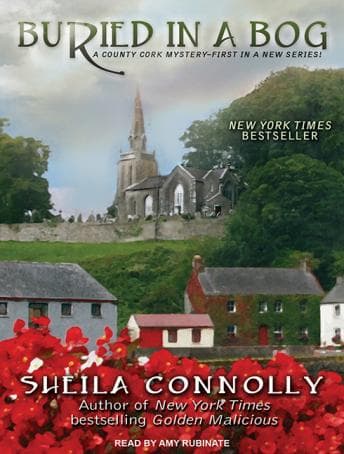

Everyone told me this was a cozy mystery. Light. Breezy. The kind of thing you listen to while folding laundry and sipping chamomile. And sure, on the surface, Buried in a Bog is exactly that - an American woman goes to Ireland, works in a pub, stumbles into a century-old murder. Cozy as a wool sweater.
But I was listening to this at midnight, alone in my kitchen, aggressively chopping onions for a chana masala I had no business making at that hour, and something about Maura Donovan's psychology kept nagging at me. Not in a good way. Not entirely in a bad way either. In an interesting way.
The Girl Who Went Looking for Roots and Found a Corpse Instead
Here's what Sheila Connolly gets right: Maura's motivation for going to Ireland is psychologically sound. She's honoring her dead grandmother's wish. She's a young woman from South Boston with limited prospects, no real family left, carrying the weight of a dead woman's nostalgia for a place she's never been. The research actually shows that second- and third-generation immigrants often feel this pull toward an ancestral homeland they've never visited - it's a form of what psychologists call "vicarious nostalgia." Connolly understands this impulse instinctively, and it gives Maura a reason to be in County Cork that doesn't feel contrived.
What's less convincing is what Maura does once she gets there. She takes a job at a pub. She just... stays. She starts investigating a body found in a bog - a body that's been there for nearly a hundred years. And I found myself asking: why does Maura really care? She has no personal stake in this dead man initially, no investigative training, no compelling reason to risk her safety. The connection between the old body and a more recent death eventually gives her some skin in the game, but it takes a while to get there. The protagonist exhibits classic amateur sleuth syndrome - curiosity without adequate justification - and whether that bothers you depends entirely on your tolerance for the genre's conventions.
The bog body angle is genuinely interesting though. There's something psychologically rich about preserved remains - a person frozen in time, their death suspended between centuries. Connolly uses this as more than a gimmick. The way the entire village gathers at the pub to discuss the discovery, the way old secrets start seeping out like water from peat - that's good mystery architecture. This is a fascinating case study in how communities hold collective memory, and how one disturbance can crack open decades of silence. I kept thinking about how Rot & Ruin does something structurally similar - a single act of disruption forcing an entire community to confront what it has collectively agreed to stop seeing.
Amy Rubinate's Ireland (Mostly Convincing, Sometimes Not)
So here's the thing about Amy Rubinate's narration: opinions are genuinely split, and having listened to the whole seven hours and forty minutes, I understand why. Her voice is clear, pleasant, and she handles the emotional register of Maura's grief and displacement with real sensitivity - there's a quality of sadness in her delivery that feels earned rather than performed.
The Irish accents? They're credible enough to carry the story if you're not Irish. If you are, or if you've spent significant time there, I suspect you'll notice the seams. It's the difference between an accent that sounds like Ireland and one that sounds like a specific village in West Cork. For a cozy mystery, the former is probably sufficient. The South Boston accent is shakier - it drifts in and out, and since Maura is supposed to be from Southie, that inconsistency pulls you out of her character at odd moments.
Where Rubinate struggles most is with what one listener called Maura's "quicksilver emotional personality" - those rapid shifts between guarded and open, between grief and dry humor. The narration tends to flatten these transitions, making Maura feel more even-keeled than I think Connolly intended. Psychologically, this doesn't track with who Maura is supposed to be: a young woman processing loss while navigating a completely foreign environment. That person should feel volatile, unpredictable. Rubinate gives us composed. It's not bad. It's just... too stable.
I'd recommend bumping the speed to 1.25x. The pacing drags in the middle sections where Maura is essentially just meeting villagers and learning the rhythms of pub life, and a slight speed increase keeps the momentum from stalling without sacrificing comprehension.
Who This Is For (And Who Should Walk Away)
If you want a mystery that'll keep you up questioning everything - this isn't it. But if you want a clean, gentle introduction to a series with a solid sense of place and a protagonist who's working through identity questions while accidentally solving crimes, Buried in a Bog delivers on that specific promise. No foul language, no graphic content. My mother would approve, and she approves of very little in my reading habits.
Fans of Irish settings will get the most mileage here. If you need tight plotting and airtight character motivations, you might find yourself frustrated. I was - a little. But I also finished my chana masala and the entire audiobook in one night, so clearly something was working.
Case Notes: Filed Under "Pleasant But Not Pathological"
Buried in a Bog is comfort food mystery. It won't change your understanding of human nature, and it won't haunt you. But Connolly knew her Ireland - she clearly loved it - and that affection is contagious enough to carry you through seven hours of pub conversations and peat bogs. Worth your time if your expectations are calibrated correctly. My therapist would have thoughts about Maura's avoidant attachment style, but that's a conversation for the sequel.