
What does it mean to watch a woman teach herself to write—literally teach herself grammar, spelling, syntax—across twenty years of diary entries, and feel that education happening in your own chest?
I started this one on a Saturday morning walk along the lakefront with Denise. She was two steps ahead of me, pointing at the fall colors, and I was somewhere in 1880s Arizona Territory watching a girl who couldn't spell "believe" correctly try to make sense of a world that kept throwing Apache raids and dead cattle and cholera at her family. By the time we looped back to the car, I wasn't ready to take out my earbuds. That should tell you something.
Sarah Prine Doesn't Ask for Your Sympathy—She Earns It
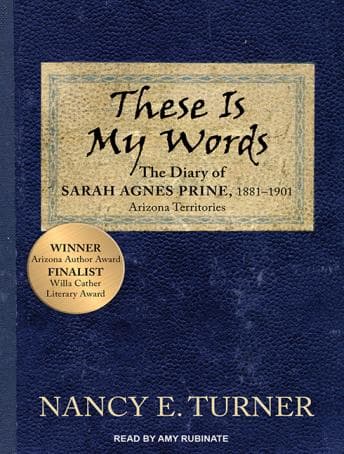
Nancy Turner based this on her own great-grandmother's life, and you can feel that ancestral weight on every page. Sarah's diary voice starts rough—intentionally rough. The grammar is broken, the observations are blunt, the emotional register is narrow because she's young and uneducated and surviving. But here's what Turner does that I think is genuinely brilliant: Sarah's prose grows. Not in some neat linear arc, but in stutters and leaps. She reads a book and suddenly her vocabulary shifts. She falls in love and her sentences get longer, more willing to linger. She suffers loss and the entries get clipped again, stripped back to bare facts because that's all grief allows.
This is why we still read the classics—or in this case, the books that feel like they should've been classics all along. The structural conceit of the diary form isn't new (Richardson did it in the 1740s, for crying out loud), but Turner uses it to do something I rarely see: she makes literacy itself a character arc. My students would hate this. I love it.
Captain Jack Elliot, the love interest, could've been a cardboard frontier hero. He's not. He's patient in a way that feels earned rather than convenient, and the slow-burn romance between him and Sarah—conducted largely through letters and awkward silences and the practical business of surviving together—is more romantic than anything with a shirtless cover. Sarah doesn't become a different person when she falls in love. She becomes more fully herself. Turner understands that distinction.
Amy Rubinate and the Problem of the Diary Voice
Here's where I need to be honest, because the listener reviews on this one are split in a way that interests me. Some folks couldn't finish the audiobook because of Rubinate's narration. I understand the complaint without fully agreeing with it.
Rubinate commits to Sarah's voice—the flatness of it early on, the limited emotional range of a teenager who processes trauma by recording facts. That's a risky choice. If you're not buying into the diary conceit, if you want a narrator who's going to give you vocal fireworks and distinct character voices from minute one, you'll bounce off this hard. But if you settle in—and I mean really settle in, at 1.0x, the way the prose deserves to be savored—you start to hear what Rubinate is doing. She's growing with Sarah. The emotional delivery in the back half of this book, once Sarah has become a woman with real command of language and feeling, lands differently because the early sections were restrained.
The narrator understands that pause is punctuation. There are moments—particularly around the losses Sarah endures, and I won't spoil which ones—where Rubinate lets silence do the work. That takes confidence.
I'll dock her slightly because character differentiation isn't her strongest suit here. In a diary-format book, you're mostly hearing one voice, which is fine, but when Sarah quotes others, the distinctions blur. It's a 13-hour-and-50-minute listen, and in a book this long, those blurred edges start to matter.
Who This Is Actually For (And Who Should Walk Away)
If you loved True Grit for Mattie Ross's voice—that stubborn, grammatically imperfect, utterly unsentimental narration of brutal events—this is its spiritual successor, stretched across two decades instead of one revenge quest. If you're the kind of listener who needs action every twenty minutes, know that this book has genuine danger and violence (this is frontier Arizona, not a Jane Austen drawing room), but it's woven between long stretches of domestic life, childbirth, crop failure, and the quiet work of building something in a place that doesn't want you there.
I finished the last two hours during a late-night grading session. Papers stacked around me, red pen untouched, because I couldn't focus on sophomore essays about symbolism in The Great Gatsby while Sarah Prine was fighting for everything she had. The ending hit me in a way I wasn't expecting—not because it's manipulative, but because Turner had spent nearly fourteen hours earning the right to break my heart a little.
This reminds me of what Hemingway said about writing one true sentence. Sarah Prine writes hundreds of them. They just happen to be misspelled at first.
Worth Pausing the Faculty Meeting For
This is a book about a woman becoming literate and powerful in a world designed to keep her neither. It's imperfect—the middle section sags slightly, and there are moments where the diary format limits Turner's ability to dramatize scenes that deserve more room. But the cumulative effect, across nearly fourteen hours, is something I haven't quite shaken. It's the kind of story that makes you want to call your grandmother and ask what she never told you. The Secret Book of Flora Lea gave me something close to that same feeling—a story where the things left unsaid between women across generations quietly accumulate until they level you.
Denise asked me what I was listening to. I told her. She said, "You look like you've been crying." I told her it was the wind off the lake. She didn't believe me. She was right not to.