
"Play the race card, the class card, the sexism card. Use any and every means at your disposal to demonize your opposition - to shut them up."
That line hit around the 45-minute mark, and I actually paused it to let Ranger out because I needed a second to decide if I was going to commit nine hours to this. I was up late, couldn't sleep - Linda was already out cold and I had one of those restless nights where your brain won't downshift. So I figured, alright Shapiro, convince me.
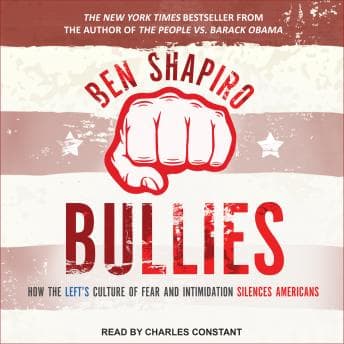
Let me cut to the chase: this book is a catalog of grievances dressed up as political analysis. Some of those grievances are legitimate. Some are well-documented. And some are delivered with the subtlety of a door-breaching charge.
Shapiro Brought Receipts - But Not All of Them Check Out
I'll give the man credit where it's due. Shapiro, who was what, 28 when he wrote this? He's sharp. Harvard Law sharp. And he does something useful here - he compiles dozens of specific incidents where left-leaning activists, media figures, and politicians used intimidation tactics to silence dissent. The section on how the race card gets weaponized against any criticism of Obama-era policy is thorough. He names names. He cites dates. He walks through the Prop 8 donor lists being used to target individuals, which is genuinely disturbing stuff regardless of where you fall on that issue.
But here's where it lost me. The book operates on a single gear: outrage. Every chapter follows the same pattern. Left-wing figure does terrible thing. Media covers for them. Conservatives are the real victims. Repeat for nine hours. There's no strategic analysis, no examination of why these tactics work psychologically, no counter-strategy beyond "we need to fight back." For a guy who went to Harvard Law, I expected more forensic dismantling and less talk radio energy.
I've seen this scenario play out in real life - I spent 25 years watching people confuse volume for authority. Doesn't matter if you're in a briefing room in Bagram or a cable news studio. Yelling louder doesn't make you more right. And Shapiro's tone here, even filtered through a narrator, is permanently set to eleven.
Charles Constant Does What He Can With What He's Got
Speaking of the narrator - Charles Constant is... fine. That's the most honest assessment I can give. He reads clearly, maintains decent pacing, doesn't stumble over the political jargon. But he also doesn't bring much texture to the material. This is essentially a long political argument, and Constant reads it like a long political argument. No dramatic modulation when Shapiro is building a case versus making a joke (and there are a few genuinely funny lines buried in here). At 1.25x, which is my standard, it clips along at a decent rate without losing clarity. But I wouldn't call this a performance that elevates the material.
The production is clean - no audio artifacts, no weird cuts. Straightforward single-narrator nonfiction. It does the job.
The Problem With a Hammer Looking for Nails
Here's my real issue, and it's not political. I've read conservative books that changed how I think. I've read liberal books that made me reassess assumptions. Good political writing - the kind that actually moves the needle - does more than confirm what you already believe. It challenges you even when you agree with the premise. Dumbing Us Down actually managed that - I went in skeptical of Gatto's thesis and came out with my assumptions genuinely rattled, which is what serious nonfiction is supposed to do.
This book doesn't do that. If you already agree with Shapiro, you'll nod along for nine hours and feel validated. If you don't, you'll be annoyed by hour two. There's no bridge-building here, no attempt to understand the psychology behind why people on the left use these tactics beyond "they're bullies and they know it." That's not analysis. That's a bumper sticker.
The chapters on media bias and the selective outrage machine are the strongest sections - Shapiro's at his best when he's doing side-by-side comparisons of how similar incidents get covered differently depending on party affiliation. That's useful work. But those moments get buried under chapters that feel more like a greatest-hits compilation of conservative grievances from 2008-2012.
And that brings up the shelf life problem. This was published in 2013. A lot of the specific examples - the Occupy Wall Street stuff, early Obama-era controversies - feel dated now. Not because the underlying dynamics have changed (if anything, they've intensified), but because the specific incidents he references have been buried under a decade of even more extreme examples from both sides.
Worth your time? Here's the debrief: if you're looking for a time capsule of conservative frustration circa 2012, this delivers exactly that. If you're looking for something that'll sharpen your thinking about political discourse and intimidation tactics? There are better options. The book needed an editor willing to cut the repetition and a second draft that asked "okay, so what do we DO about this?"
Ranger slept through most of this one. Make of that what you will.