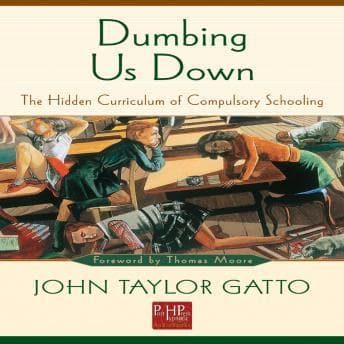

I was grading papers at 11 PM - sophomore essays on The Great Gatsby, most of them clearly written with one eye on SparkNotes - when Gatto started talking about how we've systematically trained young people to be dependent, to wait for experts to tell them what's true. I put my red pen down. Looked at the stack of identical five-paragraph essays. And felt something between validation and despair.
This is the book I've needed for twenty years. And also the book I wish I'd never heard.
When a Teacher of the Year Calls the Whole Thing a Scam
Here's what makes Gatto dangerous: he's not some outsider lobbing critiques from academia. This is a guy who won New York State Teacher of the Year - then basically said the award meant he was really good at participating in a system designed to produce compliant workers, not educated citizens. The audacity of it. I love it.
The core argument hits like a freight train. Gatto identifies seven lessons that schools actually teach, regardless of curriculum: confusion (disconnected subjects), class position (you belong where we put you), indifference (bells interrupt everything), emotional dependency (self-worth comes from grades), intellectual dependency (wait for the expert), provisional self-esteem (you're only as good as your last report card), and surveillance (you're always being watched). Gladwell explores similar power dynamics in David and Goliath, showing how institutional advantages often become liabilities—which is exactly what Gatto's arguing about our school system.
Twenty years in Chicago public schools, and I can't argue with a single one. My students don't learn to love Faulkner - they learn to perform loving Faulkner for the grade. There's a difference. Gatto knows the difference.
The Narrator Situation (Let's Just Address It)
Michael Puttonen reads this like a man delivering a lecture, which - fair enough, since much of this is drawn from Gatto's speeches and essays. His delivery is clear, steady, almost professorial. Some listeners found him annoying, and I can see why: there's a certain earnestness that borders on preachy at times. But honestly? The material is preachy. Gatto is making an argument, not telling a story. Puttonen matches that energy.
At three hours and twenty minutes, this isn't asking for a major time commitment. I finished it in two grading sessions. The brevity works - Gatto makes his points, supports them with anecdotes from his teaching career, and gets out. No padding. No repetition for emphasis. Just the argument.
(Principal Martinez, if you're somehow reading this: I was definitely not listening to a book about how institutional schooling crushes creativity during last week's curriculum meeting. Definitely not.)
The Uncomfortable Mirror
What Gatto does so well is force you to examine your own complicity. I've spent two decades assigning essays, giving grades, enforcing attendance policies. I tell myself I'm teaching critical thinking, but am I? Or am I teaching kids to produce what the authority figure wants?
He talks about his "guerrilla teaching" - letting students pursue independent projects, connecting them with real-world mentors, treating them like capable humans rather than products to be processed. And I'm sitting here thinking about how many times I've told a student their creative interpretation was "interesting but not what the rubric asked for."
The book's been in print since 2002, over 100,000 copies sold, and the system hasn't changed. That's either a failure of the book's impact or proof of Gatto's thesis about how resistant institutions are to genuine reform. Probably both.
Who Should Listen (And Who Should Skip)
Homeschooling parents will feel vindicated. Teachers like me will feel attacked - and then, if we're honest, uncomfortably recognized. Administrators will hate it. Anyone who's ever felt like school was something that happened TO them rather than FOR them will find language for that feeling.
If you believe public education just needs more funding and better testing metrics, skip this. Gatto isn't interested in reform. He's interested in demolition.
Worth Pausing the Faculty Meeting For
Listen. I'm not quitting my job. I still believe in what I do - helping teenagers discover that Hemingway's sentences are doing something, that Toni Morrison sees things the rest of us miss. But Gatto made me question HOW I do it. Whether the structures I work within undermine the very thing I'm trying to teach.
That's uncomfortable. That's valuable. That's exactly what education should do.
My students would hate this. They'd say it's too much like homework. But they'd also recognize the truth in it - the way school often feels like a game you're playing for someone else's benefit. Gatto just has the nerve to say it out loud.
Denise asked me why I was so quiet on our lakefront walk this morning. I told her I was thinking about whether I've been part of the problem for twenty years. She said that's exactly the kind of question a good teacher asks.
Maybe. Or maybe that's just what we tell ourselves to keep showing up.