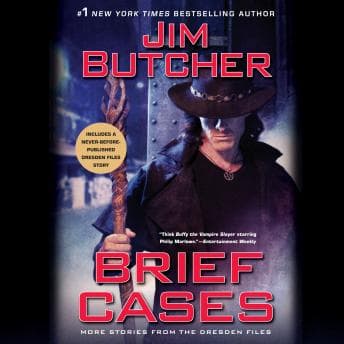
"Even Hand" — the story narrated by Jim Butcher himself, where we get a full chapter from the perspective of Gentleman Johnny Marcone — hit me around hour six, and I had to pause my shelving cart at the library and just stand there in the 92s (folklore section, naturally) processing it. Because hearing the author voice his own mob boss character with this clipped, almost too-controlled delivery? It shouldn't work. But it does something strange. It strips away all the noir bravado Harry usually filters everything through and gives you Marcone raw — the guy who keeps a comatose girl in a medical facility and considers it his one non-negotiable line. Butcher's not an actor. You can hear that. But for this particular story, the flatness reads as Marcone's emotional containment, and it's accidentally perfect.
Let me back up.
Five Narrators Walk Into a Short Story Collection
Brief Cases is twelve Dresden Files stories spread across five narrators, and the experience is less "anthology" and more "channel surfing through parallel dimensions of the same universe." James Marsters handles the lion's share — seven stories — and if you've been listening to the main novels, his Harry Dresden voice IS Harry Dresden at this point. That gravelly wiseass cadence, the way he drops into Bob the Skull's lascivious purr, the slight pause he takes before Harry says something monumentally stupid to a supernatural entity. It's muscle memory for Marsters, and it shows. The Bigfoot trilogy ("B Is for Bigfoot," "I Was a Teenage Bigfoot," "Bigfoot on Campus") benefits enormously from his consistency — you get to hear River Shoulders evolve across three stories, and Marsters gives him this deep, deliberate rumble that makes him sound like a mountain learning to be a father.
But here's where it gets interesting. Julia Whelan takes over for "Bombshells" and "Cold Case," both told from Molly Carpenter's perspective, and the tonal shift is jarring in the best way. Whelan's Molly is sharper, more anxious, less filtered than how Harry perceives her. "Cold Case" in particular — Molly's first mission as the Winter Lady — gets genuinely dark in ways the main series only hints at. Whelan doesn't soften it. There's a scene involving the obligations of the Winter Court that made me pause the audiobook and stare at my ceiling for a solid minute. She plays Molly's horror and her forced compliance with this quiet brittleness that Marsters wouldn't have been able to access because Harry's voice is inherently defiant. Molly's voice, in Whelan's hands, is someone trying not to shatter.
Oliver Wyman gets one story — "Day One," from Warden Yoshimo's POV — and it's solid if unremarkable. Cassandra Campbell opens the collection with "A Fistful of Warlocks," a Wild West Anastasia Luccio story that's fun but feels like the lightest entry. Campbell does good work with Luccio's authority, but the story itself is more adventure than anything with teeth.
The Dresden Files Are Horror and I Will Die on This Hill
Look, I know this is shelved under fantasy. I know Harry makes Star Wars references and names his cat Mister and his skull Bob. But Butcher has always understood something that a lot of fantasy writers don't — dread works better when the person experiencing it is funny. "Zoo Day," the previously unpublished story that closes the collection, is a perfect example. It's told in three rotating perspectives: Harry, his daughter Maggie, and Mouse the dog. Sounds cute, right? Sounds wholesome. And it IS, for about two-thirds of the runtime, with Maggie's sections being genuinely sweet — a little girl trying to navigate a zoo trip while carrying trauma she can barely articulate. But the story's architecture is doing something sneaky. Each perspective reveals a layer of threat the others can't see. By the time Mouse's section kicks in — and Marsters shifts into this low, protective growl for the narration — you realize the whole story has been a horror story wearing a family outing as a disguise.
This understands that horror isn't about gore — it's about dread. Butcher buries the knife early and twists it late.
Who Gets the Most Out of This (and Who Should Skip)
If you haven't read the Dresden Files through at least book twelve or so, some of these stories will feel like walking into someone else's family reunion. "Jury Duty" and "Cold Case" especially depend on your investment in the series mythology. "Even Hand" and the Bigfoot trilogy work fine as standalones, but they're appetizers without the meal.
If you're a completionist who's been listening to Marsters narrate the main series — you need this. The narrator transitions between stories are a little abrupt (no musical interludes or anything, just Butcher's author notes bridging each one), but Butcher reading his own introductions has this earnest, slightly awkward dad-at-a-reading-energy that I found weirdly charming.
I listened to most of this during late shifts at the library, reshelving after close, alone in the stacks. The particular loneliness of that experience — just you and something that refuses to be comfortable — reminded me of what I wrote about Troubles in Paradise, another thing I finished at an hour I shouldn't have. Shirley (my cat) was unimpressed. I was terrified — specifically during "Cold Case." The rest ranged from grinning to genuinely moved. "Zoo Day" made me emotional in a way I wasn't prepared for, and I say this as someone who podcasts about people getting eaten by things.
The Witching Hour Gives Its Blessing
My podcast listeners are going to love this — specifically the argument I'm going to start about whether "Even Hand" or "Zoo Day" is the better story. The answer is "Cold Case," but I want to watch the discourse. Fifteen and a half hours, five narrators, and maybe four stories that genuinely justify the full collection. But those four? They hit different. And Marsters commits. That's rare.