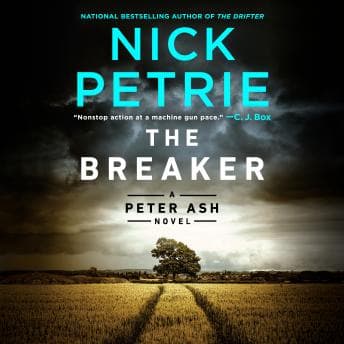

I was halfway through a stack of sophomore essays on The Great Gatsby — the ones where they all spell it "Gastby" at least once — when I realized I needed something to keep me from losing my mind. So I queued up Breaker, the sixth Peter Ash novel, expecting a straightforward action fix. Something to balance out seventeen variations of "the green light represents hope." What I got was more complicated than I bargained for, and I mean that mostly as a compliment.
Peter Ash Walks Into a Farmers Market and Ruins Everyone's Saturday
Here's the setup that hooks you: Peter Ash, a guy wanted by two governments, has built himself a quiet life in Milwaukee — renovating buildings, living with his reporter girlfriend June, trying very hard not to be the guy who runs toward gunfire. Then he sees an armed man walking into a crowded market and, because he's Peter Ash, he can't just call 911 and hide behind a cheese stand. What follows is a mystery that starts as a simple shooting and unravels into something involving autonomous killing machines, tech theft, and an assassin who's described as "eerily cheerful," which — if you've read enough thrillers — you know is always worse than a brooding one.
Nick Petrie does something smart here that elevates this above standard airport fare. He splits the investigation between Peter and June, running parallel tracks that converge. Peter and Lewis (his partner, former Marine, the kind of guy whose silence says more than most people's monologues) chase the gunman through physical confrontations. June, the journalist, digs into the victim's identity using her own skills. It's a structure that gives the book breathing room between action sequences, and it makes June feel like an actual character rather than someone who exists to worry about the protagonist.
The robot shootout in the finale — I'll just say it — stretches credibility. Petrie's been pushing Peter Ash toward increasingly high-tech threats across the series, and intelligent killer machines in a thriller set in present-day Milwaukee feels like it's reaching. But here's the thing: the emotional stakes still land. Peter's fighting not just for survival but for a clean record, for the chance to stop running. That desperation is what carries you through scenes where the technology gets a little sci-fi for my taste.
Stephen Mendel Knows Silence Is a Weapon
I've listened to Mendel narrate Peter Ash before, and the man understands something fundamental about this character: Peter is calm on the surface and barely contained underneath. Mendel's delivery for Ash is steady, controlled, almost meditative — and then when the static (Peter's PTSD-adjacent claustrophobia, his combat instincts firing) kicks in, you hear it in these subtle shifts of tension in the voice. He doesn't shout. He tightens. The narrator understands that pause is punctuation.
Lewis gets this deep, unhurried bass that immediately signals a different kind of dangerous — the kind that doesn't need to prove anything. When Lewis speaks, Mendel drops the register and slows the cadence, and it's instantly clear you're hearing a man who's been through things he doesn't talk about. The contrast with Peter's slightly wound-up calm creates a dynamic that's genuinely fun to listen to.
But the real surprise? The AI and machine voices. In a book where autonomous technology plays a significant role, Mendel had to figure out how to voice things that aren't human, and he pulls it off with this flat, precise delivery that's unsettling without being cartoonish. No robotic echo effects, no production tricks — just a shift in cadence and emotional temperature that makes the technology feel alien and present.
One note: there's a fair amount of strong language throughout. It didn't bother me (I teach high school; I've heard worse in the hallway between third and fourth period), but if that's a dealbreaker for you, consider yourself warned.
Who This Is For (And Who Should Keep Walking)
If you loved Lee Child's Reacher books but wished they had a protagonist with more visible psychological damage, Peter Ash is your guy. If you've been following the series, this is a satisfying entry that pushes the overarching plot forward — Peter's legal status, his relationship with June, the question of whether a man built for violence can build a life without it. If you're new to the series, you can start here, but you'll miss the weight of what Peter's freedom means without the earlier books.
Skip this if you need your thrillers grounded in strict realism. The killer robot element will pull you right out. And if you're looking for literary fiction disguised as genre — this isn't that. I found that same no-nonsense efficiency in Burning Bright. Petrie writes clean, propulsive prose that serves the plot. He's not trying to be Cormac McCarthy, and that's fine. Not every book needs to be Blood Meridian. (My students would hate Blood Meridian. I love it.)
Worth Pausing the Faculty Meeting For
At twelve hours, Breaker is a solid mid-length listen that moves fast enough to carry you through a weekend of grading or a long drive. Mendel's narration elevates material that could've been generic in lesser hands. The plot wobbles when the tech gets too fantastical, but the character work — especially the Peter-June dynamic, where two competent people actually communicate like adults — keeps it honest. It's not going to change your life. But at 11 PM, red pen in hand, eyes burning from run-on sentences about the American Dream? It was exactly the right book at the right time.