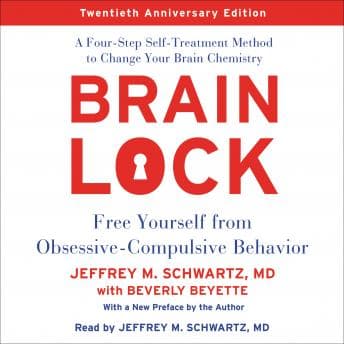

What happens when a psychiatrist tells you that the thing tormenting you — the relentless hand-washing, the checking, the intrusive thoughts you can't shake — isn't actually you? That it's just your brain misfiring, and you can learn to watch it happen without obeying it?
I was chopping onions for a chana masala at 9 PM on a Tuesday when Schwartz first laid out his core framework, and I literally put the knife down. Not because it was shocking in some dramatic way, but because the simplicity of the reframe hit me right in my research brain. The protagonist here — and yes, I'm calling OCD the protagonist, fight me — exhibits classic patterns of a hijacker. Schwartz's argument is that OCD is essentially a neurological bully, and his four-step method (Relabel, Reattribute, Refocus, Revalue) is designed to teach patients to see the bully for what it is rather than mistake it for reality.
When the Clinician Becomes the Narrator (And It Actually Works)
Schwartz narrates his own book, which is always a gamble. Authors aren't actors. But here's the thing — his delivery is clear, measured, almost professorial in the best sense. He sounds like someone explaining a case study at grand rounds, not someone performing for you. The pacing is steady, which matters for a book that's essentially asking you to internalize a cognitive framework. No dramatic pauses for effect, no over-enunciation. Just a guy who clearly knows his material walking you through it like you're a smart colleague.
That said, at nearly 11 hours, there are stretches where the clinical tone can feel a bit flat. Schwartz isn't going to suddenly develop the vocal range of a trained narrator. If you're used to audiobooks with theatrical energy, this will feel like sitting in a well-organized lecture. Which — depending on your tolerance — is either exactly right or slightly numbing.
The Four Steps as Cognitive Self-Defense
Psychologically, this is where the book earned my respect. Schwartz isn't peddling vague affirmations or "just think positive" nonsense. The research actually shows — and he cites the brain-imaging data to back it up — that his four-step method produces measurable changes in the caudate nucleus, the brain structure implicated in OCD's "sticky" thought loops. He's basically arguing that directed mental effort can rewire neural circuitry. Mind over brain. Not mind over matter — mind over brain. That distinction matters enormously.
The real-life patient stories are where the method comes alive. He walks through cases of people trapped in checking rituals, contamination fears, intrusive violent thoughts — and shows how each person applied the four steps in their own messy, imperfect way. I found myself asking: why does the Reattribute step work so well? And I think it's because it gives patients a narrative. "This isn't me, this is my OCD" is a story you tell yourself, and as someone who's built a career studying how stories shape identity, I can tell you — the stories we tell about our own minds are the most powerful ones we have.
But here's my critique, and it's not small: some of the conceptual bridges between the steps feel a little wobbly in audio format. The jump from Relabeling ("this is OCD, not reality") to Refocusing ("now go do something else for 15 minutes") makes perfect sense on paper, but in listening, without being able to flip back and reread, the connective tissue between concepts can feel thin. A few listeners have noted this, and I agree. This is a book where you might want to pause, rewind, maybe even take notes. It's not a passive listen. Honestly, the last time I felt this compelled to actually sit with a narrator's words rather than let them wash over me was reading Green Hills of Africa — Hemingway's prose demands the same kind of active, deliberate attention, and the payoff for slowing down is just as real.
Who Should Lock In (And Who Should Keep Scrolling)
If you have OCD — diagnosed or suspected — this is pretty much essential. The four-step method is now standard in treatment centers, and hearing Schwartz explain it himself carries a certain authority that a summary article can't replicate. If you're a therapist, psychology student, or anyone working in mental health, the framework here is foundational enough that you should have encountered it already, but hearing the case studies in Schwartz's own voice adds texture.
If you're looking for a general "brain hacks" book or casual pop psychology, this probably isn't your speed. It's specific. It's clinical. It's built for people who need it, not people who are curious about it. And that's fine. Not every book needs to be for everyone.
I'd also say: if you're someone who struggles with any kind of repetitive anxious thought pattern — not necessarily clinical OCD — the Relabel-Reattribute framework alone is worth the listen. My therapist would have thoughts about how many of her non-OCD clients could benefit from this exact cognitive move.
The Case Study I'd Assign My Students
Schwartz wrote this book twenty years before the anniversary edition, and the fact that the method hasn't been replaced or debunked says something. The new material in this edition adds context but doesn't reinvent the wheel — because the wheel didn't need reinventing. The narration is competent if unspectacular. The content is genuinely useful if you engage with it actively.
This is a fascinating case study in what happens when a clinician trusts patients enough to give them tools instead of just prescriptions. It's not flashy. It's not dramatic. It's just... solid science delivered by the person who did the science. And sometimes that's exactly what you need.