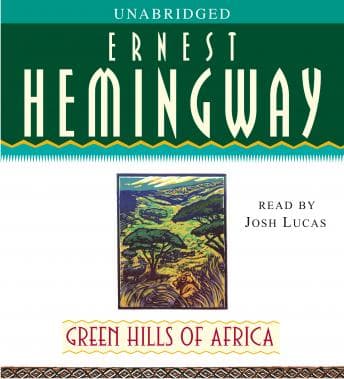

Hemingway wrote this book to prove that hunting could be literature. He was right, but not in the way he expected.
I finished Green Hills of Africa at 11:47 PM, papers half-graded on my desk, Denise already asleep. The house was quiet except for Josh Lucas reading about the Serengeti, and I found myself thinking about what Hemingway was really trying to do here. Not write a hunting memoir—anyone can do that. He was trying to capture something about obsession itself. The way a man can become consumed by the pursuit of a kudu, and how that pursuit reveals everything ugly and beautiful about him.
The Hemingway You Don't Teach in High School
My students know the iceberg theory. They've suffered through "Hills Like White Elephants" and argued about what the couple was really discussing. But this Hemingway? This is the man unfiltered, competitive to the point of absurdity, measuring his kudu horns against his hunting partner's with the intensity of a teenager comparing test scores. He's petty. He's insecure. He's magnificent.
The hunting sequences are brutal and specific—not the sanitized adventure tale you might expect. Hemingway tracks animals for days, misses shots, watches wounded creatures escape into the bush. He doesn't spare himself. When he finally gets his kudu, the triumph is mixed with something darker. This is what makes it literature instead of just a safari journal.
If you loved The Old Man and the Sea, this is its earlier, messier sibling. All the Light We Cannot See has that same quality of obsession driving its characters, though the stakes are survival rather than sport. Same fixation on the chase, same meditation on man versus nature, but without the mythological polish. Santiago's dignity is absent here—replaced with Hemingway's raw competitiveness and occasional pettiness.
Lucas Understands the Pause
Josh Lucas narrates at a pace my students would call "ancient." I call it correct.
He reads Hemingway like Hemingway wrote—with deliberate rhythm, letting the short sentences land before moving to the next. There's a passage where Hemingway describes the African plain at dawn, and Lucas holds the silence between sentences just long enough that you can almost smell the grass. That kind of immersive sensory detail reminded me of Game, where the narrator also builds atmosphere through careful pacing. Lucas understands that pause is punctuation.
His approach works because Hemingway's prose demands it. These aren't sentences you rush through. "I did not mind killing anything, any animal, if I killed it cleanly"—Lucas delivers that line with weight, no judgment, letting you sit with its implications. At 1.0x speed (the only civilized option), the six hours feel meditative rather than slow.
Some listeners apparently found it boring. I get it. If you're looking for plot momentum, this isn't your book. But if you want to understand how Hemingway thought about craft—there's a section where he discusses American literature with an Austrian stranger in the bush, ranking his contemporaries with characteristic bluntness—Lucas gives you space to absorb it.
The Pauline Problem
Here's what the Hemingway Library Edition adds: Pauline Pfeiffer's safari journal, read in full. His second wife, the one between Hadley and Martha. The one he'd eventually leave. Her perspective is fascinating and uncomfortable—she's clearly devoted, clearly trying to keep up, clearly aware that her husband is performing for some invisible audience even in the African wilderness.
The book doesn't integrate her journal smoothly. It's presented as supplementary material, which is historically accurate but narratively jarring. Still, hearing her voice alongside his adds dimension. She notices things he ignores—the servants, the logistics, the small daily negotiations of safari life. Worth pausing the faculty meeting for, if you're the kind of person who listens to Hemingway during budget presentations. (Principal Martinez, I promise I was paying attention. I wasn't.)
Who Should Hunt This Down (And Who Should Stay Home)
This is for Hemingway completists, for people who want to understand the man behind the mythology. It's for readers who don't mind that their narrator is sometimes insufferable, because insufferable people can still write sentences that stop your breath.
Skip it if you need plot. Skip it if hunting makes you uncomfortable—the kills are described with precision and something like reverence, but they're still kills. Skip it if you want the careful, controlled Hemingway of the major novels.
But if you've ever wondered what Hemingway was like when he wasn't performing? When he was just a man in Africa, desperately wanting to shoot a bigger kudu than his friend? This is that book.
Mr. Williams's Final Grade
My students would hate this. Too slow, too meandering, too much about hunting and not enough about anything they care about. I love it. Not because it's his best work—it isn't—but because it's his most honest. The prose deserves to be savored, and Lucas gives it exactly the treatment it needs.
Hemingway said about writing: "All you have to do is write one true sentence." Green Hills of Africa is full of true sentences. They just happen to be about shooting animals in 1933 Tanzania.