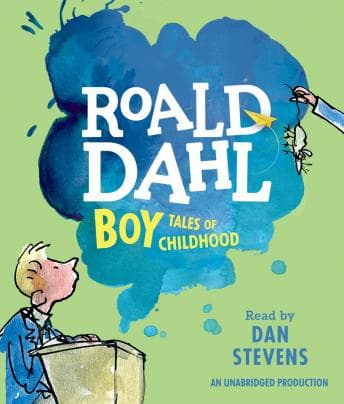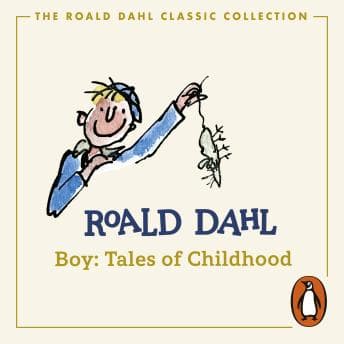

What happens when one of the most twisted children's authors of all time decides to tell the truth about his own childhood?
I picked this one up on a whim - three hours felt manageable after a brutal twelve-hour shift, and I figured some nostalgia might help me decompress before walking into my house smelling like hand sanitizer and exhaustion. Carlos and the kids were still asleep. I had coffee. I had my car. And I had Roald Dahl telling me about the time a doctor yanked out his adenoids without anesthesia while he was fully conscious.
Suddenly I was very awake.
The Man Behind the Chocolate Factory Was a Little Feral
Here's what I didn't expect: Dahl's childhood was genuinely rough in ways that explain so much about his fiction. The boarding school stories aren't cute British nostalgia - they're accounts of sadistic headmasters who caned children bloody for minor infractions. There's a car accident where young Roald nearly lost his nose. Summer holidays in Norway with his large family provide the warmth, but even those have an edge. This isn't a sanitized celebrity memoir. It's a kid surviving a world that was often cruel to children, finding mischief as his only weapon. Very Punchable Face: A Memoir has that same unflinching honesty about growing up, though with significantly less blood and caning.
As someone who's actually worked trauma, the medical scenes hit different. That adenoid removal? No anesthesia. A doctor just... went in. Dahl describes the blood, the terror, the casual brutality of early 20th century medicine practiced on children. I found myself nodding grimly. Medicine has come a long way. We forget how far.
Dan Stevens Knows Exactly What He's Doing
I've listened to a lot of narrators phone it in on children's books. Dan Stevens - yes, the Beast from Beauty and the Beast, yes, Matthew Crawley from Downton Abbey - absolutely does not phone this in. His Mrs. Pratchett, the mean candy shop woman, is this screechy, vindictive thing that made me snort-laugh in my car. The comedic timing is impeccable, especially during the Great Mouse Plot (Dahl and his schoolmates put a dead mouse in a candy jar to get revenge on her).
But here's what separates good narration from great: Stevens understands the emotional register of childhood. The humiliation of being caned. The terror of a car crash. The pure joy of Norwegian summers. He shifts between them without ever making it feel like he's performing. It just... flows. Like someone's clever uncle telling you stories, except the uncle is British and has excellent diction.
Three hours and twelve minutes. Perfect length. No padding. Dahl knew when to stop talking, which is more than I can say for most memoir writers.
Who Should Listen (And Who Should Maybe Wait)
Here's where I get practical. This is marketed as kids and family, and yes, older kids will love it. But the content warnings are real - corporal punishment, harsh treatment, some genuinely disturbing medical stuff. My twelve-year-old could handle it. My eight-year-old? Maybe not yet.
Honestly though? This is perfect for adults who grew up on Dahl and want to understand where Matilda's rage came from. Where the Trunchbull was born. Why his villains are so specifically, gleefully cruel. The answer is: he met them. They were his teachers. They were doctors who hurt him. They were adults who saw children as things to be controlled.
And he survived by being clever. By plotting revenge. By noticing everything and writing it all down.
Skip this if: you want cozy nostalgia without teeth, or you're looking for something your younger kids can listen to unsupervised.
Clocking Out in the Driveway
I finished this with the engine off, just... sitting there for a minute. Not because it was sad, exactly. But because Dahl's voice - filtered through Stevens' performance - felt like someone finally telling the truth about what it was like to be small in a world designed for adults. The mischief wasn't rebellion for rebellion's sake. It was survival.
My mom would love this. She grew up in a time and place where adults weren't questioned, where children endured what they endured. She'd recognize something in these stories. And she'd probably still say I should've been a doctor.
Carlos asked why I was sitting in the car so long. I blamed the coffee. But really, I was just thinking about how the weirdest, darkest children's author of my childhood was telling the truth the whole time. We just thought he was making it up.