
Do you know what happens to a human body when it sits at 29,000 feet for three years?
It doesn't rot. It waits.
I was listening to this on the I-10 at 4 AM, driving home after a shift where we had two traumas and a cardiac arrest, and let me tell you—the desert heat outside felt wrong after hearing about frostbite and mummification for three hours.
Usually, I spend half my commute yelling at medical thrillers. "That's not how a scalpel works!" or "Nobody uses that drug anymore!" My dashboard has heard some very colorful language. But with Kathy Reichs? I can actually shut up and listen. She's a forensic anthropologist in real life, and you can tell.
The Science of the Freeze
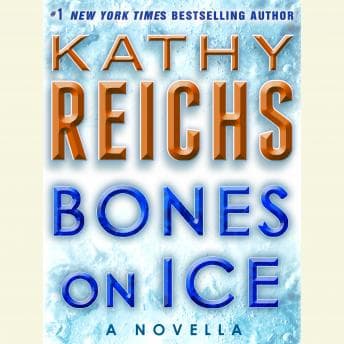
Here's the thing about Bones on Ice—it's short. A novella. Basically a long episode of the TV show, but with more internal monologue. Tempe Brennan is looking at a body recovered from the "Death Zone" on Everest.
As someone who deals with bodies that are... fresher... the details here are fascinating. Reichs describes the desiccation, the preservation, the way the cold stops time. Gruesome, sure, but accurate. Finally. (My mom would hate it, but she thinks I should be a pediatrician).
The mystery itself is solid. A girl died on the mountain, everyone said it was an accident, but the bones say otherwise. Procedural, logical, grounded in science. No magic leaps of logic, just evidence. That's my love language.
The Voice in the Passenger Seat
Okay, so let's talk about the narration. Katherine Borowitz reads this one.
Look, she's... fine.
Very clear. Very precise. She has a voice that cuts through the road noise, which I appreciate. But—and this is a big but—she's pretty flat. Everyone kind of sounds the same. Tempe sounds like the climber who sounds like the grieving parent.
It's a very "just the facts, ma'am" style. On one hand, it fits Tempe Brennan because the character is a scientist who compartmentalizes feelings (relatable). End Game had that same clinical precision in the narration, which worked for the procedural tone but didn't exactly light a fire under me during night shifts. On the other hand, at 3 AM, I need a little more energy to keep my eyes open. I didn't fall asleep, but I wasn't exactly gripping the steering wheel in suspense because of the performance. Felt a bit like listening to a very well-written shift report.
Who's This For (And Who Should Skip)
If you like the TV show Bones or just want a mystery where the author actually knows what a femur looks like, give it a shot. Skip it if you need high-energy narration to stay awake on night drives, or if you're looking for a sprawling, complex thriller. This one's a snack, not a meal.
Clocking Out
If you're expecting fifty twists and a cast of thousands, this isn't it.
But honestly? Sometimes that's all I have the brain space for. I finished it in about three commutes. It didn't demand I keep a spreadsheet of characters in my head. It respected the science. And it gave me a chilly mystery to cool down my brain after a hot, chaotic night in the ER.
Carlos asked me why I was looking up flights to Nepal when I got home. I blamed the altitude sickness.
Just maybe speed it up to 1.25x if the narrator starts sounding too much like a monotone lecturer.