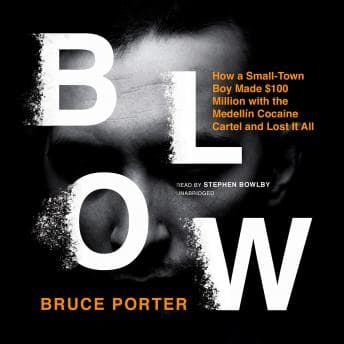

Everyone talks about the movie. Johnny Depp in those sunglasses, Penélope Cruz looking devastating, the whole thing slicked up with a Hollywood gloss that makes cocaine trafficking look like a really intense Gap commercial. So I went into Bruce Porter's Blow expecting the gritty version of a story I already knew.
What I got was something more interesting - and more psychologically uncomfortable - than I bargained for.
The Middle-Class Boy Who Needed to Be Somebody
Here's what the movie doesn't really sit with: George Jung's motivations are painfully ordinary. The protagonist exhibits classic narcissistic compensation patterns rooted in watching his father's small business fail, watching his mother's contempt for that failure, and deciding - somewhere deep in the adolescent architecture of his brain - that he would never, ever be small. Porter traces this with a journalist's patience, and it's the best part of the book. Jung doesn't start smuggling because he's a sociopath or a thrill-seeker in any exotic sense. He starts because he's a kid from Weymouth, Massachusetts who moved to Manhattan Beach, discovered weed culture, and realized he could be the guy. The guy who provides. The guy everyone calls.
I found myself asking: why does George really keep going back? After the first arrest, after the second, after Lehder turns out to be an actual Nazi-sympathizing megalomaniac - why? And Porter, to his credit, doesn't force an answer. He lets the pattern speak. The money isn't really about money. It's about the identity that money purchases. Jung literally cannot conceive of himself as ordinary. My therapist would have thoughts about this character.
This is a fascinating case study in how the American Dream and criminal enterprise share the exact same psychological infrastructure. Porter doesn't say that explicitly - he's a journalist, not a psychologist - but the material screams it.
Carlos Lehder and the Problem of the Interesting Villain
The relationship between Jung and Carlos Lehder is where the book gets genuinely unsettling. Lehder is the kind of person who'd be dismissed as unrealistic if he showed up in fiction - a Colombian car thief obsessed with John Lennon and Adolf Hitler simultaneously, who saw cocaine as both a revolutionary weapon against American imperialism and a personal ticket to absurd wealth. Porter documents how Lehder's Norman's Cay operation in the Bahamas essentially turned an entire island into a private narco-state, complete with armed guards and a landing strip.
What makes the Jung-Lehder dynamic compelling is the power inversion. Jung thinks he's the senior partner - he's American, he has the distribution networks, he's the one who taught Lehder the ropes. But Lehder has the supply, the Colombian connections, and a capacity for violence that Jung simply doesn't possess. Watching Jung slowly realize he's the junior partner in his own story is - well, it's the kind of thing I underline in case studies. The research actually shows that people in these asymmetric power relationships often maintain the fiction of equality long past the point of rationality, and Jung is a textbook example.
Porter's journalism background serves him well here. He's working from extensive interviews with Jung and others, and the level of operational detail - the weight of specific loads, the mechanics of the Norman's Cay airstrip, the financial architecture of laundering that kind of money - gives the narrative a density the film couldn't touch.
13 Hours With Stephen Bowlby
I listened to most of this while cooking a massive batch of dal makhani on a Sunday - the kind of project that takes hours of stirring and gives your hands something to do while your brain processes uncomfortable information. Bowlby's narration is steady and workmanlike. He doesn't try to do elaborate character voices or inject drama where Porter's prose is already doing the work, which I appreciated. I had a similar experience with his reading of Pitch Anything—Bowlby keeps things grounded, though that book's subject matter demands a bit more dynamism than he delivers. But he also doesn't particularly distinguish himself. For nearly 14 hours, you want a narrator who can shift energy between the operational thriller sections and the more reflective biographical passages, and Bowlby stays pretty level throughout. It's fine. It's not a performance that elevates the material, but it doesn't get in the way either.
The pacing of the book itself sags in the middle third - there's a stretch where the financial details of various deals start to blur together, and I'll admit my attention drifted somewhere around the sixth or seventh bust that somehow didn't stick. Porter occasionally over-documents at the expense of narrative momentum.
That tension between journalistic thoroughness and storytelling pace reminded me of another true-crime listen—New York to Dallas—which manages to keep the throttle open even through the procedural details.Who This Is For (And Who Should Just Rewatch the Movie)
If you watched the film and thought "that felt too clean," this is your corrective. If you're interested in the psychology of self-destruction - how someone can watch their life disintegrate in real time and still believe the next score will fix everything - Porter gives you the raw material. If you just want the highlight reel, the movie honestly does that better.
Psychologically, this doesn't track as a redemption story, even though Jung sometimes frames it that way. It tracks as a study in compulsive identity maintenance. And that's darker, and more honest, and ultimately more worth your time.
My Clinical Notes
Porter wrote a true crime book that functions, almost accidentally, as a psychological portrait of American aspiration gone sideways. The narration won't blow you away, but the material will make you uncomfortable in the right ways. Spend a long Sunday with it. Make something complicated while you listen. You'll need your hands busy.