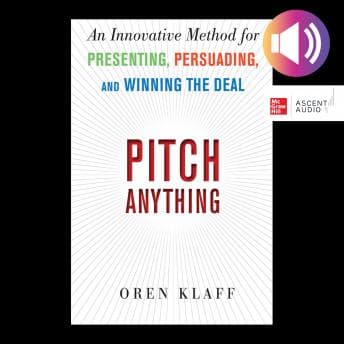

Look, I need to complain about something first. Oren Klaff spends the opening chapters telling us how he's raised $400 million and how every pitch he's ever given has basically turned skeptical VCs into drooling fans. The humble-bragging is... a lot. I was prepping for a client call at 6 AM, coffee in hand, and I actually paused the audiobook to text my wife: "This guy." She responded with a single eye-roll emoji. She gets it.
But here's the thing—and I hate admitting this—the man has a point. Several points, actually. By hour two, I'd stopped rolling my eyes and started taking mental notes.
The Frame Game Actually Works
Klaff's core concept is "frame control"—the idea that every business interaction is a battle between competing frames, and whoever controls the frame controls the outcome. Sounds like consultant-speak, right? That's what I thought. But then he breaks down the "crocodile brain" theory—how the primitive part of your audience's brain filters pitches before the rational mind ever gets involved—and suddenly I'm thinking about every failed pitch I've witnessed at McKinsey.
The STRONG method (Setting the Frame, Telling the Story, Revealing the Intrigue, Offering the Prize, Nailing the Hookpoint, Getting a Decision) is genuinely useful. Not because it's revolutionary—my parents did half of this instinctively when negotiating with suppliers—but because Klaff gives you specific language and tactics. When he talks about "prizing" yourself (making the buyer feel like they need to qualify for YOU), I immediately recognized it from every successful deal I've closed. I just never had vocabulary for it. Motivation Myth does something similar—giving you language for instincts you already had but couldn't articulate.
When the War Stories Land
Klaff's real-world examples are where this book earns its keep. There's a pitch he describes where he walks into a room full of hostile airport executives, and instead of launching into his presentation, he reframes the entire meeting by challenging their assumptions about who holds the power. It's uncomfortable to hear. It's also exactly the kind of move I've seen work in boardrooms—when you have the nerve to pull it off.
Stephen Bowlby's narration is clean and professional. Nothing flashy, which is appropriate here. This isn't a book that needs dramatic performance—it needs clarity. Bowlby delivers Klaff's confidence without making it sound even more insufferable than it already is on the page. That's a skill.
Where It Gets Thin
Here's my problem: Klaff's examples are almost exclusively high-stakes venture capital and M&A situations. Raising $25 million for an airport deal is not the same as pitching a mid-market client on a consulting engagement. He acknowledges this briefly, then moves on. If you're selling B2B services or negotiating salary—situations he promises the book covers—you'll need to do translation work yourself.
The "alpha" energy throughout gets exhausting. There's a section where he essentially advises you to make your audience slightly uncomfortable to maintain frame control. Effective? Probably. Sustainable for long-term business relationships? I've seen this fail at three different companies. The aggressive frame-setting works great for one-time transactions. Less great when you need that client to return your calls next quarter.
At 6 hours 15 minutes, though, the book respects your time. No padding. No unnecessary tangents into Klaff's childhood or meditation practice. He gets in, delivers the framework, illustrates with stories, gets out. That efficiency reminded me of You Need a Budget—another no-nonsense framework that cuts straight to what works.
Who This Is (and Isn't) For
If you pitch investors, sell high-ticket services, or negotiate deals where psychology matters more than spreadsheets—this is worth your credit. The frame control concepts alone will change how you prepare for meetings.
If you're in transactional sales, customer service, or any role requiring long-term relationship building—skip to chapters on storytelling and intrigue, take what's useful, ignore the alpha posturing. Some of the attitude? Not so much.
Jenny would say I'm being harsh. Jenny is right. But I'm also being accurate.
The Consultant's Bottom Line
I've recommended this to three startup founders this month. All of them came back saying some version of "I hate how much I liked it." That's the perfect summary. Klaff is not someone I'd want to grab drinks with. But his framework is solid, his examples are memorable, and his method actually works.
Better method, more money—that's his tagline. He's not wrong. I just wish he'd said it with 40% less swagger.