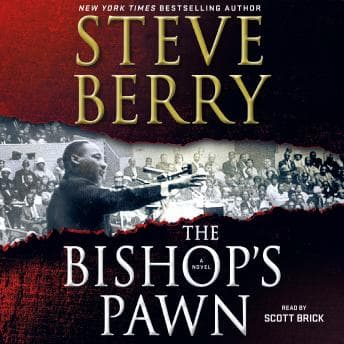

Steve Berry wrote a thriller about the MLK assassination and got the FBI parts more right than most authors get a basic IV insertion.
Let me back up. I was two hours into a brutal Saturday night shift — one of those nights where the trauma bay was quiet but the whole unit had that prickling feeling, like the air before a monsoon — and I'd already mentally queued this up for my morning drive home. By the time I actually got in the car at 7:15 AM, sun blazing through my windshield, I was ready for something that would keep my brain occupied enough to not replay the shift but not so intense I'd miss my exit. Bishop's Pawn hit that exact sweet spot. Mostly.
Cotton Malone Before He Was Cotton Malone
Here's what Berry does that I genuinely respect: he takes his long-running series hero and strips him back to his early career. Young Navy lawyer Cotton Malone, not yet the seasoned operative we know from thirteen books. And the first-person perspective — which is apparently a departure for the series — actually works for this because you're inside the head of a guy who doesn't yet know what kind of man he's going to become. He's reckless in ways that feel earned, not manufactured.
The historical angle is where this book really grabbed me. The Hoover-King feud, the secret files, the suggestion that the official assassination narrative might be incomplete — Berry weaves real history with fiction in a way that made me pull into my driveway and just... sit there. With the engine running. Carlos texted asking if I was okay. I was fine. I was just in the Dry Tortugas with a rare coin and a conspiracy.
But — and this is a real but — some of the action sequences drag. There are chase scenes that go on long enough that I started mentally triaging them. "This fight scene is a priority 3, Steve. We can move on." The bars in Mexico, the physical confrontations — they pull you out of the intellectual puzzle that is the book's real strength. It's like padding a chart with unnecessary vitals when the patient's diagnosis is already clear.
Three Narrators Walk Into a Recording Booth
Scott Brick is the main engine here, and look, the man knows what he's doing. His pacing during the conspiracy reveals is excellent — he lets the tension build without overselling it. When Malone starts piecing together the connection between the coin and the secret files, Brick's delivery shifts just enough that you feel the stakes rising without being hit over the head with drama.
Kevin R. Free handles portions well, though I'll be honest — the transitions between narrators aren't always smooth. It's not jarring enough to ruin anything, but you notice the handoff. The real surprise is Berry himself reading the Writer's Cut commentary. And here's where my night shift brain actually perked up: the behind-the-scenes annotations where Berry explains what's real history versus what he invented? That's the good stuff. That's the author's note I always want and rarely get. He tells you which FBI documents are real, which locations are real, what he extrapolated. As someone who lives in a profession where the difference between fact and educated guess can be life or death — I appreciated the transparency.
When the History Hits Harder Than the Fiction
I'll be real. The moments that stuck with me weren't the thriller set pieces. They were the quiet historical reveals about King's surveillance, about what Hoover's FBI was willing to do to destroy a man. There's a weight to those sections that the Mexico bar fights just can't match. Berry clearly did his homework, and when he's laying out the alternate history of April 4, 1968, the book becomes something more than a beach read thriller. That same quality — where the real history underneath the fiction starts to feel heavier than the plot itself — is exactly what made In Cold Blood linger with me long after I finished it, and why I keep recommending it to people who think they don't like true crime.
My mom called me on my day off and I ended up telling her about the book for twenty minutes. She grew up hearing about MLK from a completely different cultural lens — Filipino immigrant perspective, newly arrived in the '70s, learning American history through her kids' textbooks. She wants to listen to it now. My mom would love this (she still thinks I should've been a doctor).
The first-person narrative won't work for everyone. Some longtime Cotton Malone fans apparently felt alienated by it, and I get that — if you're used to a certain voice for thirteen books and suddenly the whole perspective shifts, it's disorienting. For me, coming in without that baggage, it felt intimate in a way third person wouldn't have.
Who Needs This in Their Ears
If you're a history nerd who likes your facts mixed with just enough fiction to keep things dangerous — yes. If you want pure action thriller pacing with no slow spots — maybe manage your expectations. The middle section asks for patience. If you're a Cotton Malone completist, this origin story fills in gaps you probably didn't know you had. And if you're driving home from a shift where you've been dealing with real life-and-death stakes, this is grounded enough to hold your attention without spiking your already elevated cortisol.
Perfect for that post-shift decompression. At 1.25x speed, the pacing issues smooth out and you still catch every historical detail Berry drops.
Night Shift Discharge Orders
Solid historical thriller with a narrator who knows the assignment, dragged down slightly by action scenes that overstay their welcome. The Writer's Cut commentary is the real bonus — Berry showing his work is worth the price of admission alone. Not his tightest book, but the history he's mining here deserves your attention. Night shift approved.