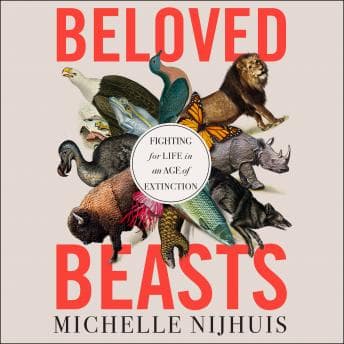

This is basically a git blame for the entire conservation movement, and honestly? It's way more riveting than that sounds.
I started this on a rare WFH day - Kevin was out, apartment was quiet, and I was batch-cooking congee while pretending I wasn't going to spend the whole afternoon debugging a flaky integration test. Nijhuis's voice (well, Christina Delaine's voice) filled my kitchen for about four hours before I realized the congee had gone from soup to cement. Worth it.
The Commit History of Caring About Animals
What makes this book different from your standard "we're destroying the planet" doom scroll is that Nijhuis traces conservation as an idea - one that evolved, mutated, and occasionally went horribly sideways. She doesn't just name-drop Aldo Leopold and Rachel Carson and move on. She digs into the uncomfortable stuff: the Audubon Society's origins tangled up with elite white social clubs, the way early wildlife preservation in Africa was basically colonialism wearing a safari hat, the eugenics-adjacent thinking that infected parts of the movement well into the 20th century. The chapter on how the American bison was "saved" partly as a nationalist project - and what that meant for Indigenous communities who'd depended on bison for millennia - hit differently than I expected.
But here's the thing that kept me engaged through ten and a half hours: Nijhuis isn't cynical about it. She lays out the failures honestly and then shows how the movement course-corrected (or tried to). It's like watching a codebase improve over generations of maintainers, some brilliant, some with terrible judgment, all building on what came before. The arc from "save this one pretty bird" to "maybe we should think about entire ecosystems" to "oh wait, this is also about human communities and justice" - that progression is the actual story, and it's surprisingly gripping.
The Lesser-Known Contributors Get Their Merge Requests Approved
The best parts are the people I'd never heard of. Rosalie Edge, this society woman in the 1930s who basically declared war on the Audubon Society's own leadership because they were too cozy with gun manufacturers - she read like a character someone invented. William Hornaday, the early wildlife advocate who was also a raging racist and saw conservation as a way to keep "lesser peoples" out of American wilderness. Nijhuis doesn't sanitize any of these figures, and she doesn't do the lazy thing of writing them off entirely either. She holds the contradiction and lets you sit with it. That same willingness to hold moral complexity without forcing a verdict reminded me of Bryan Stevenson's approach in Just Mercy - different subject entirely, but the same refusal to let the reader off the hook with easy conclusions.
The whooping crane sections were genuinely tense - following the species from something like 15 wild birds back from the edge. And the black rhino conservation efforts in Africa get into the thorny politics of who gets to decide what happens to wildlife when the people making decisions and the people living alongside the animals are very different populations. That's where the book gets its real weight.
Audio Quality: Solid but Not a Star
Christina Delaine does a competent job. Clean narration, good pacing, professional. But I'll be honest - this is nonfiction that reads like very good longform journalism, and the narration matches that energy. Steady, clear, no frills. It doesn't need a Ray Porter performance (though imagine him on Hornaday's more unhinged quotes - that would've been something). Delaine handles the tonal shifts well enough, moving from the almost absurdist early conservation drama to the heavier colonial critique sections without it feeling jarring.
At 1.5x, this flows perfectly. I bumped to 1.75x for a few of the organizational history sections that got a bit into the weeds - the formation of various wildlife agencies blurred together a bit around the midpoint - but mostly 1.5x was the sweet spot.
Who Should Queue This Up (And Who Shouldn't)
Perfect for: train, walks, housework. Any context where you want to learn something real without needing to take notes. Skip for: if you want prescriptive "here's what to do about climate change" action items - this is history, not a playbook. Also skip if you need constant narrative momentum; there are stretches in the middle where it's more survey-course than thriller.
If you liked The Sixth Extinction but wished it spent more time on the humans trying to stop the extinctions rather than just documenting them, this is your book. If you're in tech and think about systems design, the way Nijhuis frames conservation as an iterative, often-failing attempt to design solutions for massively complex systems - yeah, that'll feel familiar.
The ROI on This One
TL;DR: Worth your commute. The ROI on this audiobook is high if you care even a little about environmental science or the messy history of social movements. I finished it in about 4 commutes plus that one congee-destroying afternoon, and I came away knowing a lot more about why conservation looks the way it does today - and why it needs to change. Not a must-listen, but solidly worth the credit. The kind of book that makes you slightly more interesting at dinner parties, which - let's be real - is half the reason we listen to nonfiction anyway.







![Steve Jobs [unabridged audiobook] audiobook cover](/_next/image?url=https%3A%2F%2Fcovers.audiobooks.com%2Fimages%2Fcovers%2Ffull%2F9788499923406.jpg&w=1920&q=75)