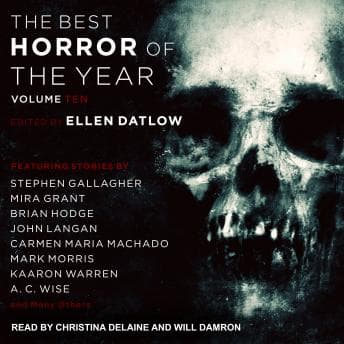
I was dismantling a "Summer Beach Reads" display at the library—which, let's be honest, is its own specific kind of horror—while listening to this. There's something profoundly perverse about listening to cosmic dread while stacking paperbacks featuring shirtless men and golden retrievers. It felt like a private joke between me and the abyss.
Ellen Datlow is basically the patron saint of "I'm not sleeping tonight." If you know the genre, you know she doesn't mess around with cheap jump scares. She curates the kind of fiction that makes you side-eye your own furniture. Pretties had that same effect on me—different flavor of unsettling, but equally effective at making the familiar feel wrong. Volume 10 keeps that streak alive. We're talking heavy hitters like Neil Gaiman and Laird Barron—authors who understand that horror isn't about the monster; it's about the shadow the monster casts.
The Anthology Lottery
Here's the problem with audio anthologies, though: The Voice Match. In a written collection, your internal monologue shifts naturally from Gaiman's whimsical darkness to Barron's gritty noir. In audio, you're at the mercy of the narrators to make that pivot.
We've got Christina Delaine and Will Damron here. On paper? Solid pros. In practice? It's... complicated.
When you have two people voicing a massive roster of distinct authorial voices, things get muddy. I found myself wishing for a full cast. Damron is steady—he's got that gravitas that works well for the more brooding, atmospheric pieces. But Delaine made some choices that didn't sit right with my 2 AM brain.
The "Campfire Counselor" Problem
I need to address the "overacting" complaints I've seen floating around, because they aren't wrong. There are moments where the narration leans too hard into "Spooky Voice™." You know what I mean—that breathy, trembling cadence that sounds like a camp counselor trying to scare twelve-year-olds.
For the more literary, subtle stories, this theatricality actually kills the tension. Horror works best when it's grounded in reality before the rug gets pulled out. Confessor understood this—it built slowly, earned its scares. When the narrator starts at a 10 on the Creep-O-Meter, there's nowhere to go. It turns dread into melodrama. I found myself checking the runtime, not because I was bored, but because the performance was exhausting me.
That said, when the story matches the energy—specifically the more fantastical or high-concept entries—it works. But for the quiet, domestic horror? It felt like using a sledgehammer to hang a picture frame.
Who Should Queue This Up (And Who Shouldn't)
If you're new to Datlow's anthologies and want to sample her taste, start with the print edition. If you're a completist who needs every volume in audio, temper your expectations for the performance. Skip entirely if theatrical narration pulls you out of subtle horror—you'll spend more time annoyed than unsettled.
Shirley the Cat Has Spoken
Shirley slept through the whole thing, which is usually a bad sign. She wakes up for real tension.
This is a collection of five-star stories trapped in a three-star production. Datlow's curation is, as always, impeccable. She finds the weird, the uncomfortable, and the profound. But the audio format flattens the distinct textures of these writers into a somewhat generic performance.
If you're a die-hard Datlow fan, you're going to listen anyway. But honestly? This might be one of the rare times I tell you to grab the physical book. The stories deserve to be read in your own voice, not filtered through a performance that doesn't always trust the material to be scary on its own.