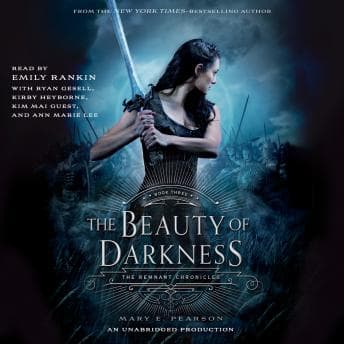

Everyone kept telling me this was the most satisfying YA fantasy conclusion they'd ever listened to. And look — I get it. Pearson wraps up a lot of threads, delivers the romance payoff, stages some genuinely tense political maneuvering. But I found myself doing something I rarely do with a final book in a trilogy: I kept pausing to argue with the characters.
Not because they're badly written. Because they're almost perfectly written, and the gaps bugged me more than they should have.
When Your Therapist Would Side-Eye Lia's Decision-Making
Lia is fascinating as a psychological subject. She's spent two books learning to trust her gift, navigating betrayal, surviving captivity — and in this final installment, she's supposed to be stepping into her power. And she does, mostly. But Pearson makes a choice that I keep circling back to: Lia's leadership arc relies heavily on others recognizing her authority before she fully claims it herself. The protagonist exhibits classic external validation patterns that feel realistic for a teenage princess-on-the-run, sure. But for an 18-hour-and-40-minute conclusion? I found myself asking: why does Lia really need this many scenes of proving herself to skeptical men before she just... acts?
The research actually shows that narrative satisfaction in trilogy conclusions correlates with protagonist agency — readers want characters who've earned their transformation to use it. Pearson gets there eventually. The political scenes in Morrighan's court, where Lia has to navigate her father's kingdom while carrying intelligence from Venda, are genuinely sharp. But the middle hours drag because the setup keeps resetting Lia's confidence meter.
Rafe, meanwhile — Ryan Gesell voices him with this steady, low-key earnestness that works for the romance but flattens some of his more interesting moments. Rafe's a king pretending not to be one, which is a psychologically rich setup. But Gesell reads him with such consistent warmth that you lose the calculating edge Rafe should have. The guy is strategizing while he's being romantic, and that duality doesn't always land in audio.
Five Narrators, One Character Who Steals It
Here's where I got surprised. This is a five-narrator production — Emily Rankin for Lia, Gesell for Rafe, Kirby Heyborne for Kaden, Kim Mai Guest for Pauline, Ann Marie Lee for the interstitial material. And the clear standout? Heyborne as Kaden.
Kaden is the character I'd write a whole paper about. He's a Vendan assassin with genuine emotional attachment to Lia, operating inside a moral framework that doesn't map neatly onto hero or villain. This is a case study in cognitive dissonance — loyalty to a regime he's beginning to question versus feelings he can't fully articulate. The psychological architecture of that kind of moral unraveling is something Douglas and Olshaker map with clinical precision in Killer Across the Table — and reading that book made me even more attuned to the moments when Kaden's ideological loyalty starts cracking under the weight of something he can't rationalize away. Heyborne reads him with this restrained intensity, like someone perpetually swallowing what he actually wants to say. It's the performance that made me lean into my headphones during a very long Saturday cooking session. (I was making dal makhani from scratch. My mother's recipe. The kind of project that takes four hours and benefits enormously from an audiobook that actually holds your attention.)
Rankin is solid as Lia — clear, emotionally available, good instincts for when to push intensity. Kim Mai Guest as Pauline brings warmth to what could be a thankless best-friend role. Ann Marie Lee handles the Remnant lore passages with appropriate gravity, though some of those prophetic sections feel overwrought on the page and the audio can't entirely save them.
The multi-narrator approach works well for clarity — you always know whose head you're in. But here's the thing: the narrators don't really interact with each other's energy. Each one exists in their own vocal bubble. It's clean, professional, consistent. It's also a little bloodless. For a story about war, betrayal, and desperate love, I wanted more friction in the performances.
The Psychology of Endings (And Why Pearson Almost Nails It)
What makes this series compelling is that Pearson understands power as a psychological phenomenon, not just a plot device. Lia's gift — her ability to sense truth, to feel the weight of ancient knowledge — is essentially heightened intuition weaponized. And the conflict between Lia's intuitive knowledge and the institutional power structures around her? That's real. That's something I see in research subjects, in case studies, in my own life as a woman in academia who sometimes knows something is true before she can prove it in a way the committee will accept.
But the ending wraps things up almost too neatly. The romantic resolution, the political resolution, the mystical resolution — they converge in a way that feels earned emotionally but psychologically? A little too clean. People who've been through what these characters have been through don't just... settle into happiness. My therapist would have thoughts about this character arc. Several thoughts.
Still. Eighteen hours is a commitment, and I don't regret it.
Who This Is Actually For (And Who Should Bail)
If you've listened to the first two books, obviously finish the trilogy. If you haven't started — this isn't a standalone situation, don't even try. This is for readers who love YA fantasy with genuine political stakes, who don't mind romance taking up significant real estate, and who want multiple POVs that actually serve the plot rather than padding the runtime.
Skip it if: unrealistic conflict resolution makes you itch, or if you need your fantasy protagonists to earn their endings through more than prophecy and good intentions. Psychologically, some of the character arcs don't track as tightly as I'd want. But Pearson understands human nature well enough that I kept listening through my irritation, and that's worth something.
Case Study: Closed (With Reservations)
A strong conclusion that does right by its characters about 80% of the time. Heyborne's Kaden is worth the listen alone. The production is clean and professional without being inspired. And Pearson writes political intrigue better than she writes prophecy, which is fine — I'll take court machinations over mystical vagueness any day. Not a perfect ending, but a satisfying one. Mostly.