
"I'm quite hard to shock, but this has been a very shocking evening."
Somewhere around hour three, Magnus Bane is being his chaotic immortal self in 1920s New York, and I'm sitting cross-legged on my apartment floor sorting my Gloomhaven components because apparently I hate myself. And I realize — this is basically a D&D character's backstory written across centuries. An immortal warlock with daddy issues, a rotating cast of lovers, and a talent for showing up at the exact wrong historical moment? That's not a Shadowhunter side character. That's someone's level 20 Hexblade patron with a Google Calendar full of catastrophes.
Eight Hundred Years of Terrible Life Decisions
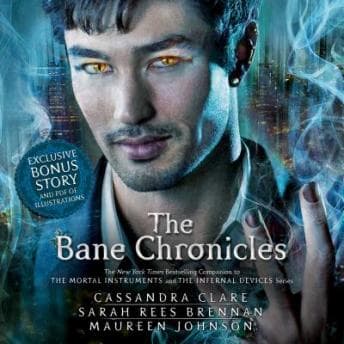
So here's the thing about The Bane Chronicles as a concept: it's eleven short stories spanning Magnus's very long, very dramatic life. Peru in the 1700s. London during the era of The Infernal Devices. New York in the Jazz Age. And... a trip to IKEA with Alec. (Yes, really.) The tonal whiplash is kind of the point. Magnus is the connective tissue, and his voice — sarcastic, lonely underneath all the glitter, occasionally devastating when he lets his guard down — holds it together better than you'd expect from what is essentially a short story anthology.
The stories co-written with Maureen Johnson tend to lean funnier and lighter. The Sarah Rees Brennan collabs dig into darker territory. You can feel the different authorial hands, which in a novel would be a problem, but here it actually mirrors how Magnus himself shifts between personas across decades. Sometimes he's the life of the party. Sometimes he's watching everyone he loves age and die. The whiplash is earned.
But I'll be honest — some of these stories land harder than others. The ones tied directly to the Shadowhunter timeline (especially "The Course of True Love and First Trials") feel like they need you to have read at least The Mortal Instruments to care about the stakes. The historical ones — Magnus in Prohibition-era New York, Magnus dealing with the aftermath of losing a lover — stand more on their own. If you're coming in cold, you'll get maybe 60% of the emotional payoff.
The Multiple-Narrator Gamble
Here's where I have to level with you: the research on the specific narrators is frustratingly thin. What I can tell you is that using different narrators for different stories is a bold choice for an anthology built around one character. In theory, it gives each era its own flavor. In practice, you're adjusting to a new voice for Magnus every story or two, and that takes a beat each time. It's like recasting the Doctor in Doctor Who — some regenerations land smoother than others.
The multi-narrator approach does prevent fatigue across 13 hours, which matters. And since each story has its own setting and supporting cast, switching voices actually reinforces the sense that we're jumping through time. But if you're the kind of listener who needs to bond with a narrator's rhythm (and I am — Steven Pacey walked so other narrators could run, and I mean that), the constant switching can feel more like channel surfing than immersion.
No reports of audio glitches, no pronunciation disasters, no production issues. Simon & Schuster Audio keeps it clean. Just... don't expect the kind of narrator-character fusion you get from a single performer across a 40-hour epic.
Who Gets an Invite to This Party (And Who Gets Ghosted)
If you're already in the Shadowhunter universe and you love Magnus — and look, he's one of the best things Clare ever created — this is a no-brainer. It fills in backstory you didn't know you wanted and gives you Magnus/Alec content that the main series kept sidelining. The LGBTQ+ representation feels genuine, not tokenized, and Magnus's bisexuality is treated as just... part of who he is across centuries. Which it should be.
If you haven't read any Cassandra Clare? This is a weird entry point. Some stories will work, some will feel like reading someone else's text messages without context. Start with The Mortal Instruments or The Infernal Devices first.
If you don't like info-dumps, this isn't for you (but you're wrong). Dense lore delivery is genuinely an art form, and I say that as someone who sat through Inferno doing its historical exposition thing across half of Florence — sometimes the info-dump IS the experience. Some of the worldbuilding lore drops here — the Downworlder politics, the history of the Spiral Labyrinth — are genuinely cool and expand the universe in ways the main novels don't have room for.
My D&D group would love this as inspiration for a warlock backstory. Eight hundred years of accumulated regrets, bad decisions, and occasional heroism? That's a character sheet that writes itself.
Save Your Spell Slots for the Good Stories
The Bane Chronicles is uneven. That's the nature of anthologies, especially ones with three different co-authors. But the highs — Magnus's grief, his humor, his stubborn refusal to become cynical after centuries of loss — those hit. I read this instead of writing my thesis, and while Dr. Patel would not approve, I don't regret the 13 hours. I just wish the format let any single narrator really own Magnus the way the character deserves.